

2026 Updated Palo Alto Networks CloudSec-Pro Certification Study Guide Pass CloudSec-Pro Fast
CloudSec-Pro Dumps PDF 2026 Program Your Preparation EXAM SUCCESS
NEW QUESTION # 34
The exclamation mark on the resource explorer page would represent?
- A. resource has been deleted
- B. resource has compliance violation
- C. resource has alerts
- D. the resource was modified recently
Answer: C
Explanation:
https://docs.paloaltonetworks.com/prisma/prisma-cloud/prisma-cloud-admin/investigate-incidents-on-prisma- cloud/investigate-config-incidents-on-prisma-cloud
NEW QUESTION # 35
In Azure, what permissions need to be added to Management Groups to allow Prisma Cloud to calculate net effective permissions?
- A. PaloAltoNetworks.PrismaCloud/managementGroups/descendants/read
- B. Microsoft.Management/managementGroups/descendants/read
- C. Microsoft.Management/managementGroups/descendants/calculate
- D. PaloAltoNetworks.PrismaCloud/managementGroups/
Answer: B
Explanation:
In Azure, to enable Prisma Cloud to calculate net effective permissions across Management Groups, the necessary permission is "Microsoft.Management/managementGroups/descendants/read." This permission grants Prisma Cloud the ability to read the management group hierarchy and the related details, allowing for a comprehensive analysis of the effective permissions applied across different levels of the management group structure. By having this level of access, Prisma Cloud can accurately assess and report on the permissions assigned to various resources and identities within the Azure environment, facilitating better security and compliance management.
NEW QUESTION # 36
Which alerts are fixed by enablement of automated remediation?
- A. All applicable open alerts regardless of when they were generated, with alert status updated to
"resolved" - B. Only the open alerts that were generated after the enablement of remediation, with alert status updated to "resolved"
- C. All applicable open alerts regardless of when they were generated, with alert status updated to
"dismissed" - D. Only the open alerts that were generated before the enablement of remediation, with alert status updated to "resolved"
Answer: A
Explanation:
When automated remediation is enabled in Prisma Cloud, it is designed to address all applicable open alerts, regardless of when they were generated. The system automatically applies remediation actions to resolve the identified security issues or compliance violations that triggered the alerts. Once the remediation actions are successfully completed, the system updates the status of the affected alerts to "resolved," indicating that the security issues have been addressed. This feature helps streamline the remediation process, reducing the manual effort required by security teams and ensuring that security issues are promptly resolved to maintain the integrity and security of the cloud environment.
NEW QUESTION # 37
Which Prisma Cloud policy type can protect against malware?
- A. Network
- B. Data
- C. Config
- D. Event
Answer: B
Explanation:
The "Data" policy type in Prisma Cloud is specifically designed to protect against threats related to data, including malware. These policies focus on securing data at rest and in transit, implementing data loss prevention (DLP) mechanisms, and scanning data stores and payloads for malicious content. By employing data policies, Prisma Cloud ensures that data stored within cloud environments is safeguarded against unauthorized access, exfiltration, and malware, thereby maintaining the integrity and confidentiality of sensitive information.
NEW QUESTION # 38
Given the following JSON query:
$.resource[*].aws_s3_bucket exists
Which tab is the correct place to add the JSON query when creating a Config policy?
- A. Build Your Rule (Run tab)
- B. Details
- C. Compliance Standards
- D. Remediation
- E. Build Your Rule (Build tab)
Answer: E
Explanation:
When creating a Config policy in Prisma Cloud and incorporating a JSON query, the correct place to add this query is under the "Build Your Rule (Build tab)" (Option E). This section allows users to define the criteria and conditions for the policy, including specifying JSON or RQL (Resource Query Language) queries that articulate the policy's logic. The "Details" (Option A) tab is typically used for general information about the policy, such as its name and description. The "Compliance Standards" (Option B) tab is for associating the policy with specific compliance frameworks. The "Remediation" (Option C) tab provides guidance on how to remediate any issues detected by the policy. The "Build Your Rule (Run tab)" (Option D) is not a standard option in Prisma Cloud policy configuration.
NEW QUESTION # 39
What should be used to associate Prisma Cloud policies with compliance frameworks?
- A. Policies
- B. Alert rules
- C. Custom compliance
- D. Compliance
Answer: C
Explanation:
In the context of associating Prisma Cloud policies with compliance frameworks, the most appropriate option is "Custom compliance." Prisma Cloud provides a comprehensive set of security and compliance policies that can be applied to cloud environments. While predefined policies cover a wide range of compliance standards and best practices, every organization has unique requirements and may follow specific compliance frameworks that are not directly included in the predefined policies. Custom compliance allows organizations to define their own compliance frameworks and associate specific Prisma Cloud policies with these custom frameworks. This flexibility ensures that organizations can maintain compliance with their specific regulatory and industry standards, tailoring the Prisma Cloud policies to meet their unique compliance needs. Custom compliance frameworks can be created within Prisma Cloud to include a collection of policies that address the specific controls and requirements of the organization's chosen compliance standards, providing a tailored approach to cloud security and compliance.
NEW QUESTION # 40
Which categories does the Adoption Advisor use to measure adoption progress for Cloud Security Posture Management?
- A. Visibility, Security, and Compliance
- B. Visibility, Compliance, Governance, and Threat Detection and Response
- C. Network, Anomaly, and Audit Event
- D. Foundations, Advanced, and Optimize
Answer: B
Explanation:
The Adoption Advisor uses four categories to measure adoption progress for Cloud Security Posture Management: Visibility, Compliance, Governance, and Threat Detection and Response. Visibility helps to identify the resources in the environment and to ensure that security controls are in place. Compliance helps to ensure that the environment is meeting regulatory and industry standards. Governance helps to ensure that the environment is secure and managed according to policy. Threat Detection and Response helps to detect and respond to threats quickly and effectively.
The Adoption Advisor in Prisma Cloud uses categories such as Visibility, Compliance, Governance, and Threat Detection and Response to measure adoption progress for Cloud Security Posture Management (CSPM). These categories represent key areas of focus for effectively managing and securing cloud environments. Visibility refers to the ability to see and understand all cloud resources and their configurations. Compliance involves ensuring that cloud resources comply with regulatory standards and best practices. Governance encompasses the policies and procedures that control cloud resource usage and security. Threat Detection and Response involves identifying and mitigating security threats to the cloud environment. By measuring adoption progress across these categories, organizations can assess how well they are utilizing CSPM capabilities to secure their cloud environments.
NEW QUESTION # 41
A manager informs the SOC that one or more RDS instances have been compromised and the SOC needs to make sure production RDS instances are NOT publicly accessible.
Which action should the SOC take to follow security best practices?
- A. Enable "AWS S3 bucket is publicly accessible" policy and add policy to an auto-remediation alert rule.
- B. Enable "AWS RDS database instance is publicly accessible" policy and for each alert, check that it is a production instance, and then manually remediate.
- C. Enable "AWS S3 bucket is publicly accessible" policy and manually remediate each alert.
- D. Enable "AWS RDS database instance is publicly accessible" policy and add policy to an auto- remediation alert rule.
Answer: B
Explanation:
Following best practices, the Security Operations Center (SOC) should enable a policy that checks for publicly accessible AWS RDS database instances and then manually remediate each instance confirmed to be part of the production environment. This approach ensures that only those resources that should not be publicly accessible are modified, avoiding unintended access restrictions on non-production instances.
NEW QUESTION # 42
Given the following audit event activity snippet:
Which RQL will be triggered by the audit event?
A)
B)
C)
D)
- A. Option C
- B. Option A
- C. Option D
- D. Option B
Answer: C
NEW QUESTION # 43
What is the maximum number of access keys a user can generate in Prisma Cloud with a System Admin role?
- A. 0
- B. 1
- C. 2
- D. 3
Answer: B
Explanation:
Reference: https://docs.paloaltonetworks.com/prisma/prisma-cloud/prisma-cloud-admin/manage-prisma- cloud-administrators/create-access-keys.html#:~:text=You%20can%20enable%20API%20access,generate%
20one%20access%20key%20only
In Prisma Cloud, a user with a System Admin role can generate a maximum of 2 access keys. These keys are used for API access and automation, enabling secure and controlled interactions with Prisma Cloud's capabilities.
NEW QUESTION # 44
Which order of steps map a policy to a custom compliance standard?
(Drag the steps into the correct order of occurrence, from the first step to the last.)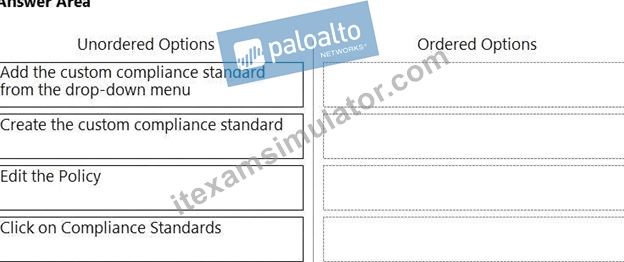
Answer:
Explanation: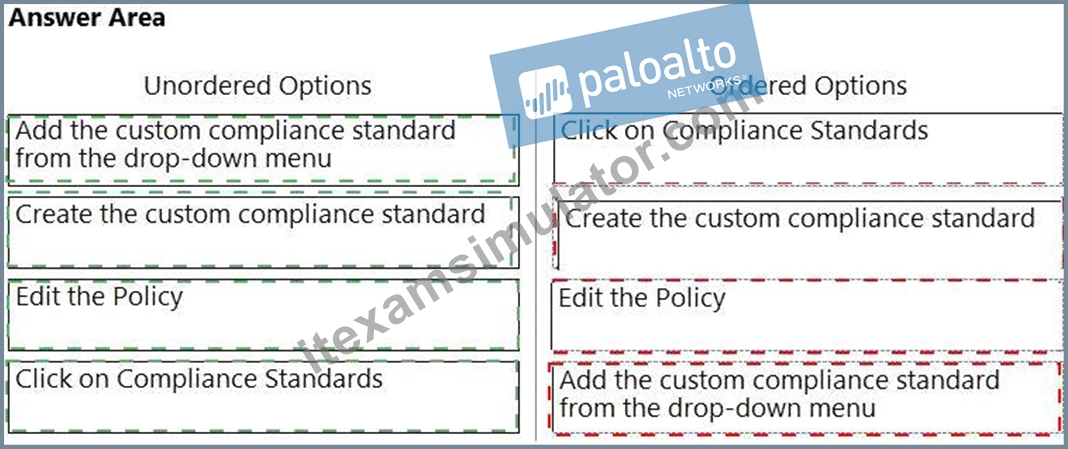
Explanation:
1. click on compliance standard.
2. add custom compliance standard.
3. edit policies.
4. add compliance standard from drop-down menu
https://docs.prismacloudcompute.com/docs/enterprise_edition/compliance/custom_compliance_checks.
html#creating-a-new-custom-check
The process of mapping a policy to a custom compliance standard in a security platform like Prisma Cloud by Palo Alto Networks involves several specific steps. Firstly, one must access the compliance standards, which is typically done by clicking on the "Compliance Standards" section within the platform's interface. This is where all standards, including custom and predefined ones, are listed.
Next, if the custom compliance standard does not already exist, it must be created. This step involves defining the criteria and controls that make up the standard, tailored to the organization's specific requirements.
Once the custom compliance standard is in place, the policy in question needs to be edited. This editing process would involve configuring the policy to align with the compliance controls outlined in the custom standard, ensuring that the policy will enforce or check for the necessary requirements as defined by the standard.
Finally, the last step is to formally associate or map the edited policy with the custom compliance standard.
This is typically done by adding the policy to the standard, which may involve selecting the custom compliance standard from a drop-down menu within the policy settings, confirming that this particular policy should be enforced as part of the compliance checks for that standard.
This ordered process ensures that policies are properly aligned with the organization's compliance goals and can be enforced and reported on accurately within the security platform.
NEW QUESTION # 45
A customer has multiple violations in the environment including:
User namespace is enabled
An LDAP server is enabled
SSH root is enabled
Which section of Console should the administrator use to review these findings?
- A. Vulnerabilities
- B. Compliance
- C. Radar
- D. Manage
Answer: B
Explanation:
The correct section of the Console that the administrator should use to review findings such as "User namespace is enabled", "An LDAP server is enabled", and "SSH root is enabled" is "Compliance".
The "Compliance" section in CSPM tools like Prisma Cloud provides an overview of the current compliance posture against various regulatory standards and best practices. It can help identify configurations that do not adhere to best practices or that may violate compliance requirements, such as enabling the user namespace, which could be a security risk, or having an LDAP server and SSH root enabled, which may not comply with certain security standards.
Reference to the use of the "Compliance" section can be found in CSPM documentation, where it details how compliance checks are used to assess the security and configuration of cloud resources against established benchmarks and standards, allowing organizations to maintain compliance and improve their security posture.
NEW QUESTION # 46
What are the subtypes of configuration policies in Prisma Cloud?
- A. Build and Deploy
- B. Build and Run
- C. Security and Compliance
- D. Monitor and Analyze
Answer: B
Explanation:
In Prisma Cloud, configuration policies are categorized to align with the different phases of the cloud security lifecycle, emphasizing a holistic approach to cloud security management. The subtypes "Build and Run" encapsulate this approach by covering both the development phase (Build) - where cloud resources and applications are designed and created, and the operational phase (Run) - where these resources and applications are deployed and actively used. This categorization ensures that security and compliance are integral throughout the lifecycle, from the initial creation of cloud infrastructure and applications to their deployment and day-to-day operation, thereby enhancing the overall security posture.
NEW QUESTION # 47
Which container image scan is constructed correctly?
- A. twistcli images scan --address https://us-west1.cloud.twistlock.com/us-3-123456789 --container myimage/ latest --details
- B. twistcli images scan --address https://us-west1.cloud.twistlock.com/us-3-123456789 myimage/latest
- C. twistcli images scan --address https://us-west1.cloud.twistlock.com/us-3-123456789 --container myimage/ latest
- D. twistcli images scan --docker-address https://us-west1.cloud.twistlock.com/us-3-123456789 myimage/ latest
Answer: B
Explanation:
The correct construction for scanning a container image using the TwistCLI tool in Prisma Cloud is option B.
This command specifies the address of the Prisma Cloud Console and the image to be scanned, including its tag. The TwistCLI tool is part of Prisma Cloud's capabilities to integrate security into the CI/CD pipeline, allowing for the scanning of images for vulnerabilities as part of the build process, thus ensuring that only secure images are deployed.
NEW QUESTION # 48
Prisma Cloud Compute has been installed on Onebox. After Prisma Cloud Console has been accessed.
Defender is disconnected and keeps returning the error "No console connectivity" in the logs.
What could be causing the disconnection between Console and Defender in this scenario?
- A. The license key provided to the Console is invalid.
- B. Port 8084 is not open for Console and Defender communication.
- C. Onebox script installed an older version of the Defender.
- D. Port 8083 is not open for Console and Defender communication.
Answer: B
Explanation:
By default, Defender is configured to communicate with Console on port 8084. If port 8084 is closed, then Defender cannot communicate with Console. https://knowledgebase.paloaltonetworks.com/KCSArticleDetail?
id=kA10g000000PNWXCA4#:~:text=If%20port%208084%20is%20closed%2C%20then%20Defender%
20cannot%20communicate%20with%20Console.&text=Resolve%20the%20issue%20by%20setting,%3E%
20Load%20Balancer%20%3E%20Defender).
NEW QUESTION # 49
Which three types of buckets exposure are available in the Data Security module? (Choose three.)
- A. Conditional
- B. Differential
- C. Private
- D. International
- E. Public
Answer: A,C,E
Explanation:
In the Data Security module of cloud security platforms like Prisma Cloud, the types of bucket exposures typically include Public (option A), Private (option B), and Conditional (option E). Public buckets are accessible by anyone on the internet, posing a significant data leakage risk. Private buckets are restricted to authorized users only, offering a higher level of security. Conditional exposure involves buckets that may be accessible under certain conditions or to specific users, requiring careful configuration and policy enforcement to prevent unauthorized access. International (option C) and Differential (option D) do not represent standard types of bucket exposures in cloud security contexts.
NEW QUESTION # 50
......
Get Perfect Results with Premium CloudSec-Pro Dumps Updated 260 Questions: https://www.itexamsimulator.com/CloudSec-Pro-brain-dumps.html
Free CloudSec-Pro Exam Study Guide for the NEW Dumps Test Engine: https://drive.google.com/open?id=16BY54rVUoqJES1rCgYVHCOydnLSgcDtY
