

300-620 PDF Dumps | Aug 29, 2022 Recently Updated Questions
300-620 Exam Questions – Valid 300-620 Dumps Pdf
Prerequisites
Thus, the Cisco 300-620 exam is intended for network and security practitioners, including network engineers, network designers, and systems engineers. This professional-level certification test authenticates one’s skills in working with data center solutions and allows them to keep up the pace with the ever-changing trends using advanced data center technologies as well as implement them in their daily tasks. Before sitting for this exam, you should deal with the core test and also prepare for the content that will be covered in it.
The whole path covers the details of core technologies and proves your ability to use best practices in designing, troubleshooting, and implementing the infrastructure of a modern data center, configuration of series switches, or usage of the automation for data center solutions. Therefore, you need to be ready for these topics.
Understanding functional and technical aspects of Implementing Cisco Application Centric Infrastructure (300-620 DCACI) Security Policies and Procedures
The following will be discussed in CISCO 300-620 exam dumps:
Customers changing application requirements need a flexible approach that is simple, more agile, and application-centric. Ease of provisioning and speed are critical performance metrics for data center network infrastructure that support physical, virtual, and cloud environments-without compromising scalability or security.
Cisco Application Centric Infrastructure (Cisco ACI) is a comprehensive software-defined networking (SDN) architecture. This solution provides a network that is deployed, monitored, and managed in an application-centric way. It uses business-relevant language that benefits different teams working with and within the IT organization.
- Configure External Layer 2 (L2Out) Connection
- Configure an upgrade
- Implement AAA and RBAC
- Enable Inter-EPG Layer 2 Connectivity
- Implement configuration backup (snapshot/config import export)
- Enable Inter-EPG Layer 3 Connectivity
- Configure External Layer 3 (L3Out) Connection
- Distributed Virtual Switch (DVS)
NEW QUESTION 29 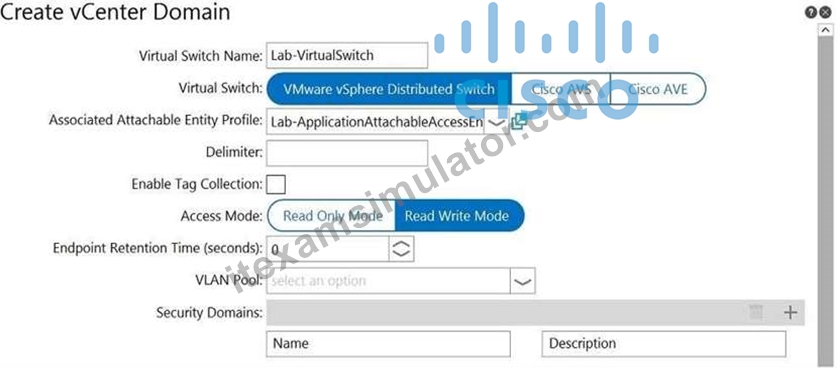
Refer to the exhibit. An engineer is integrating a VMware vCenter with Cisco ACI VMM domain configuration.
ACI creates port-group names with the format of "Tenant | Application | EPG". Which configuration option is used to generate port groups with names formatted as "Tenant=Application=EPG"?
- A. virtual switch name
- B. security domains
- C. enable tag collection
- D. delimiter
Answer: A
Explanation:
Section: Integrations
NEW QUESTION 30
An ACI administrator notices a change in the behavior of the fabric. Which action must be taken to determine if a human intervention introduced the change?
- A. Inspect audit logs in the APIC UI to see all user events.
- B. Inspect /var/log/audit_messages on the APIC to see a record of all user actions.
- C. Inspect event records in the APIC UI to see all actions performed by users.
- D. Inspect the output of show command history in the APIC CLI.
Answer: C
NEW QUESTION 31
Which two dynamic routing protocols are supported when using Cisco ACI to connect to an external Layer 3 network? (Choose two.)
- A. eBGP
- B. RIPv2
- C. iBGP
- D. VXLAN
- E. IS-IS
Answer: A,C
NEW QUESTION 32
A data center administrator is upgrading an ACI fabric. There are 3 APIC controllers in the fabric and all the servers are dual-homed to pairs of leaf switches configured in VPC mode. How should the fabric be upgraded to minimize possible traffic impact during the upgrade?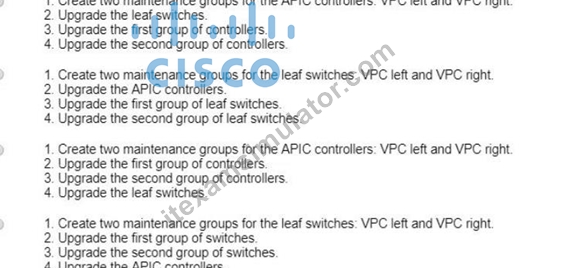
- A. Option A
- B. Option C
- C. Option B
- D. Option D
Answer: C
NEW QUESTION 33
Refer to the exhibit.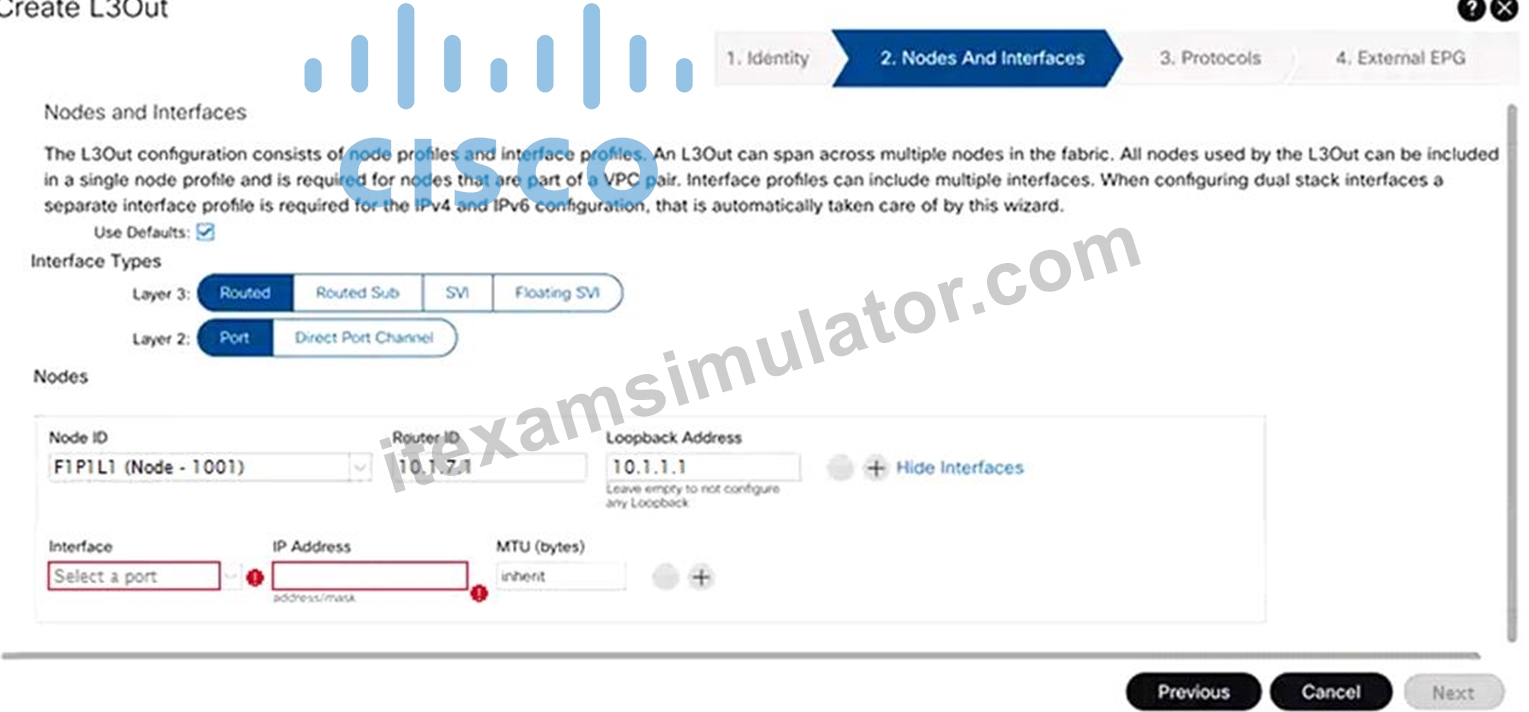
An engineer must configure an L3Out peering with the backbone network. The L3Out must forward unicast and multicast traffic over the link. Which two methods should be used to configure L3Out to meet these requirements? (Choose two.)
- A. VPC with SVI
- B. Layer 3 routed subinterface
- C. port channel with SVI
- D. Layer 3 floating SVI
- E. Layer 3 routed port
Answer: B,E
Explanation:
https://www.cisco.com/c/en/us/solutions/collateral/data-center-virtualization/application-centricinfrastructure/ guide-c07-743150.html#_L3Out_sStatic_rRoutes
https://www.cisco.com/c/en/us/td/docs/switches/datacenter/aci/apic/sw/4-x/L3-configuration/Cisco-APIC-Layer-3-Networking-Configuration-Guide-401/Cisco-APIC-Layer-3-Networking-Configuration-Guide-401_chapter_010010.html
NEW QUESTION 34
Which endpoint learning operation is completed on the ingress leaf switch when traffic is received from a Layer 3 Out?
- A. The source MAC address of the traffic is learned as a local endpoint.
- B. The source MAC address of the traffic is learned as a remote endpoint.
- C. The source IP address of the traffic is learned as a local endpoint.
- D. The source IP address of the traffic is learned as a remote endpoint.
Answer: B
NEW QUESTION 35
An engineer must advertise a bridge domain subnet out of the ACI fabric to an OSPF neighbor. Which two configuration steps are required? (Choose two.)
- A. Create Route Control Profile with the export direction under External EPG.
- B. Add L50ut profile to the bridge domain using Associated L30uts section
- C. Add External Subnet for External EPG flag under External EPG.
- D. Configure the Subnet under the EPG level.
- E. Configure Subnet scope to Advertised Externally
Answer: B,E
NEW QUESTION 36
When configuring Cisco ACI VMM domain integration with VMware vCenter, which object is created in vCenter?
- A. datacenter
- B. VMware vSphere Standard vSwitch
- C. VMware vSphere Distributed Switch
- D. cluster
Answer: C
NEW QUESTION 37
Which statement regarding ACI Multi-Pod and TEP pool is true?
- A. The same TEP pool is used in all Pods.
- B. A different TEP pool must be assigned to each Pod.
- C. The IP addresses used in the IPN network can overlap TEP pool of the APIC.
- D. The Pod1 TEP pool must be split and a portion of the TEP pool allocated to each Pod.
Answer: B
Explanation:
Reference:
https://www.cisco.com/c/en/us/solutions/collateral/data-center-virtualization/application-centric- infrastructure/white-paper-c11-739714.html
NEW QUESTION 38
Which components must be configured for the BGP Route Reflector policy to take effect?
- A. leaf fabric interface overrides and profiles
- B. access policies and profiles
- C. pod policy groups and profiles
- D. spine fabric interface overrides and profiles
Answer: C
Explanation:
Reference:
https://www.cisco.com/c/en/us/td/docs/switches/datacenter/aci/apic/sw/4-x/L3-configuration/Cisco- APIC-Layer-3-Networking-Configuration-Guide-401/Cisco-APIC-Layer-3-Networking-Configuration-Guide- 401_chapter_01.html
NEW QUESTION 39
Which two actions extend a Layer 2 domain beyond the ACI fabric? (Choose two.)
- A. extending the EPG out of the ACI fabric
- B. creating an external physical network
- C. extending the bridge domain out of the ACI fabric
- D. creating a single homed Layer 3 Out
- E. extending the routed domain out of the ACI fabric
Answer: A,C
NEW QUESTION 40
All workloads in VLAN 1001 have been migrated into EPG-1001. The requirement is to move the gateway address for VLAN 1001 from the core outside the Cisco ACI fabric into the Cisco ACI fabric. The endpoints in EPG-1001 must route traffic to endpoints in other EPGs and minimize flooded traffic in the fabric. Which configuration set is needed on the bridge domain to meet these requirements?
- A. Disable Local IP Learning Limit Disable Unicast Routing
- B. Enable Hardware Proxy Enable Unicas! Routing
- C. Disable ARP Flood
Disable Limn Endpoint Learning - D. Enable Flood
Enable Unicast Routing
Answer: B
NEW QUESTION 41
An engineer configured a bridge domain with the hardware-proxy option for Layer 2 unknown unicast traffic.
Which statement is true about this configuration?
- A. The spine switch drops the Layer 2 unknown unicast packet if it is unable to find the MAC address in the proxy database.
- B. The Layer 2 unknown hardware proxy lacks support of the topology change notification.
- C. The leaf switch forwards the Layers 2 unknown unicast packets to all other leaf switches if it is unable to find the MAC address in its local forwarding tables.
- D. The leaf switch drops the Layer 2 unknown unicast packet if it is unable to find the MAC address in the local forwarding tables.
Answer: D
Explanation:
Section: ACI Packet Forwarding
NEW QUESTION 42
A customer migrates a legacy environment to Cisco ACI. A Layer 2 trunk is configured to interconnect the two environments. The customer also builds ACI fabric in an application-centric mode. Which feature should be enabled in the bridge domain to reduce instability during the migration?
- A. Enable Flood in Encapsulation.
- B. Set Multi-Destination Flooding to Flood in BD.
- C. Disable Endpoint Dataplane Learning
- D. Set Multi-Destination Flooding to Flood in Encapsulation.
Answer: B
NEW QUESTION 43
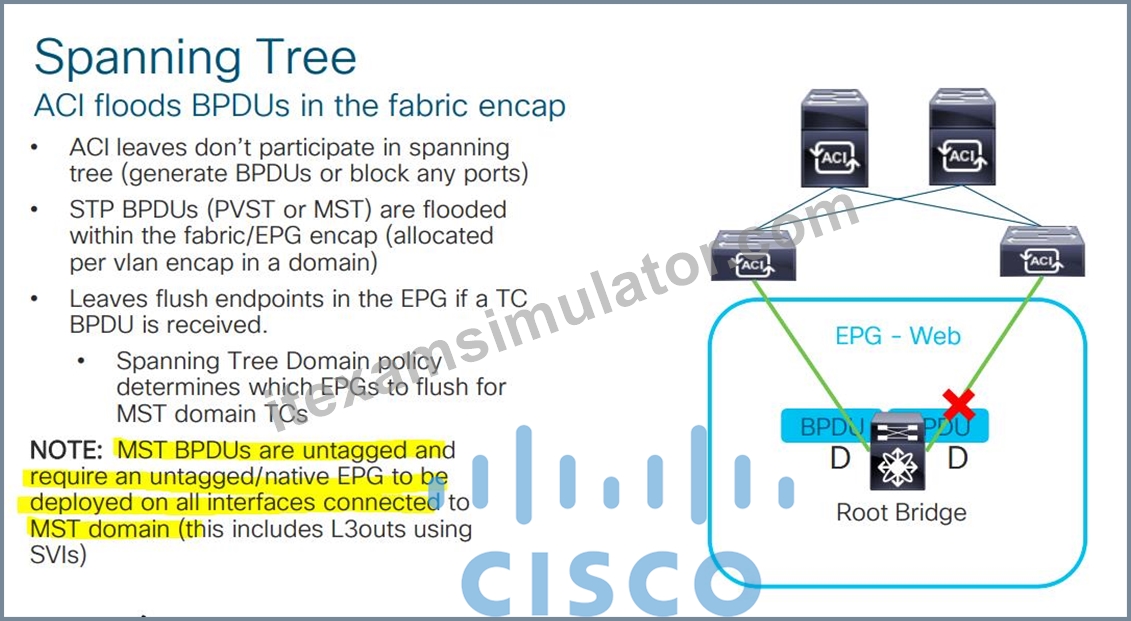
An engineer must connect Cisco ACI fabric using Layer 2 with external third-party switches. The third-party switches are configured using 802.1s protocol. Which two constructs are required to complete the task?
(Choose two.)
- A. MCP instance policy with administrative slate disabled
- B. static binding of native VLAN in all existing EPGs
- C. MCP policy with PDU per VLAN enabled
- D. dedicated EPG for native VLAN
- E. spanning tree policy for mapping MST Instances to VLANs
Answer: D,E
Explanation:
https://www.ciscolive.com/c/dam/r/ciscolive/emea/docs/2019/pdf/BRKACI-3101.pdf
https://www.cisco.com/c/en/us/solutions/collateral/data-center-virtualization/application-centric-infrastructure/white-paper-c07-732033.html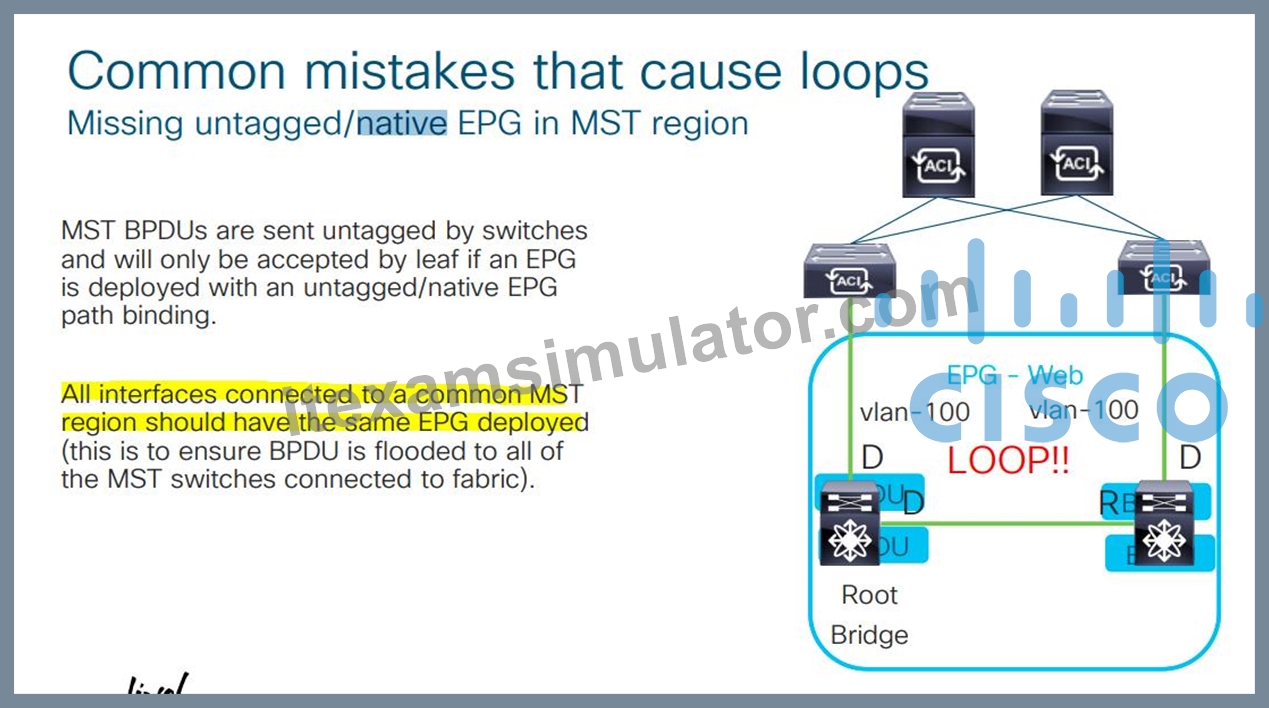

NEW QUESTION 44
In the context of ACI Multi-Site, when is the information of an endpoint (MAC/IP) that belongs to site 1 advertised to site 2 using the EVPN control plane?
- A. Endpoint information is not exchanged across sites unless COOP protocol is used.
- B. Endpoint information is not exchanged across sites unless a policy is configured to allow communication across sites.
- C. Endpoint information is exchanged across sites when the endpoints are discovered in both sites.
- D. Endpoint information is exchanged across sites as soon as the endpoint is discovered in one site.
Answer: A
Explanation:
Reference:
https://www.cisco.com/c/en/us/solutions/collateral/data-center-virtualization/application-centric- infrastructure/white-paper-c11-739609.html#CiscoACIMultiSiteoverlaydataplane
NEW QUESTION 45
An engineer created two interface protocol policies called Pol_CDP40275332 and Pol_LLDP46783451. The policies must be used together in a single policy. Which ACI object must be used?
- A. switch profile
- B. switch policy group
- C. interface policy group
- D. interface profile
Answer: D
NEW QUESTION 46
Refer to the exhibit.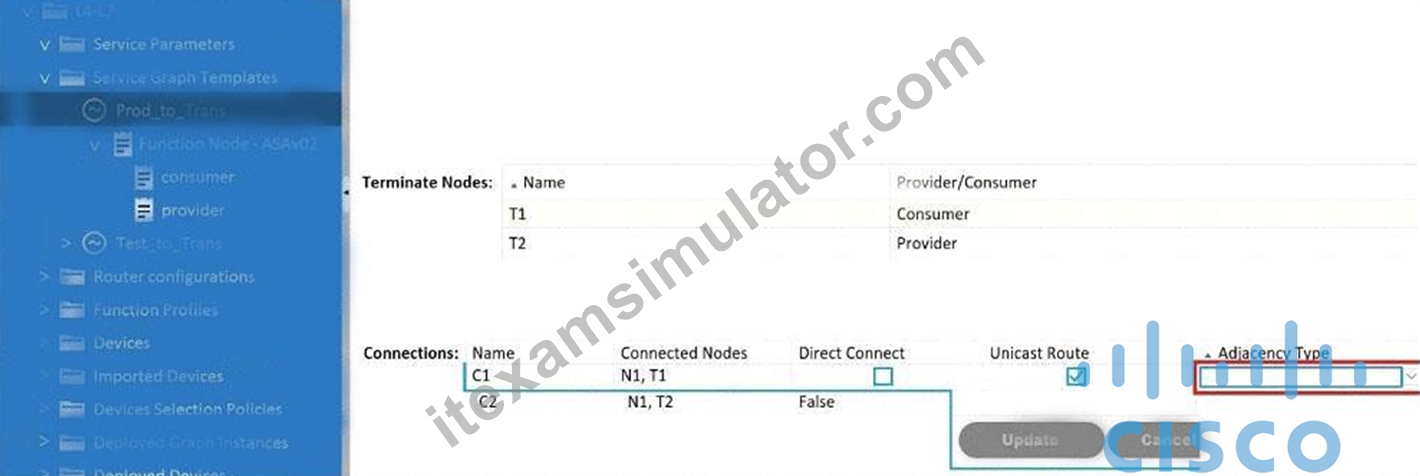
Which Adjacency Type value should be set when the client endpoint and the service node interface are in a different subnet?
- A. Routed
- B. L3Out
- C. Unicast
- D. L3
Answer: A
NEW QUESTION 47
An engineer is configuring a VRF for a tenant named Cisco. Drag and drop the child objects on the left onto the correct containers on the right for this configuration.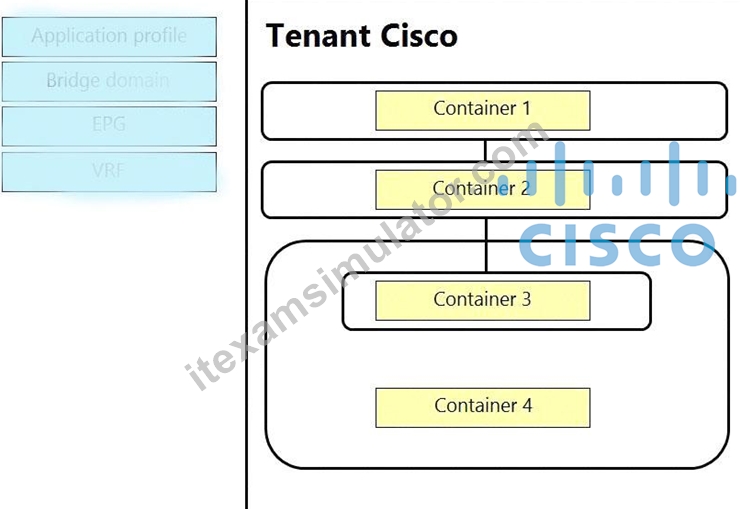
Answer:
Explanation: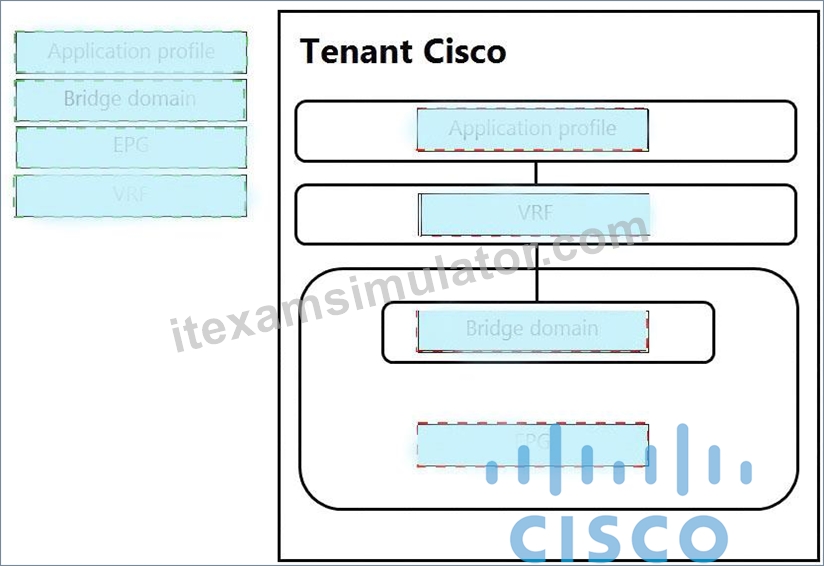
Explanation
Application profile---> VRF--> Bridge Domain---> EPG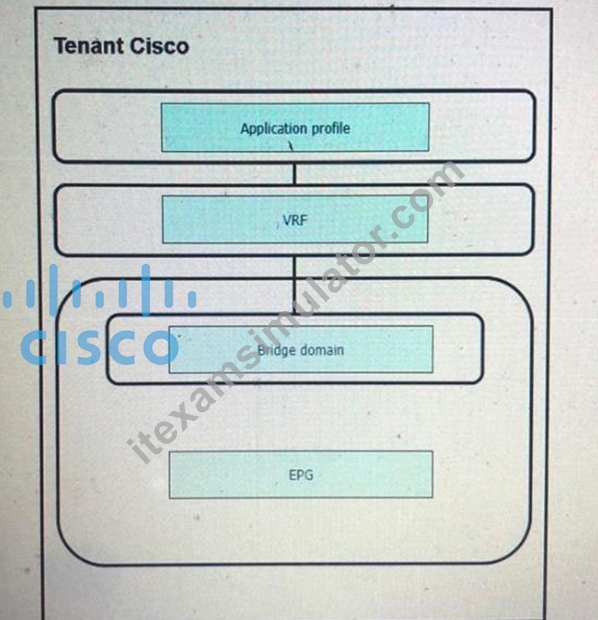
NEW QUESTION 48
A situation causes a fault to be raised on the APIC. The ACI administrator does not want that fault to be raised because it is not directly relevant to the environment. Which action should the administrator take to prevent the fault from appearing?
- A. Create a stats threshold policy with both rising and falling thresholds defined so that the critical severity threshold matches the squelched threshold.
- B. Under System -> Faults, right-click on the fault and select Acknowledge Fault so that acknowledged faults will immediately disappear.
- C. Under System -> Faults, right-click on the fault and select Ignore Fault to create a fault severity assignment policy that hides the fault.
- D. Create a new global health score policy that ignores specific faults as identified by their unique fault code.
Answer: C
NEW QUESTION 49
Which table holds IP address, MAC address and VXLAN/VLAN information on a Cisco ACI leaf?
- A. RIB
- B. endpoint
- C. adjacency
- D. ARP
Answer: B
Explanation:
Reference:
https://www.cisco.com/c/en/us/solutions/collateral/data-center-virtualization/application-centric- infrastructure/white-paper-c11-739989.html
NEW QUESTION 50
In the context of VMM, which protocol between ACI leaf and compute hosts ensures that the policies are pushed to the leaf switches for immediate and on demand resolution immediacy?
- A. LLDP
- B. STP
- C. VXLAN
- D. ISIS
Answer: A
Explanation:
Immediate-Specifies that EPG policies (including contracts and filters) are downloaded to the associated leaf switch software upon ESXi host attachment to a DVS. LLDP or OpFlex permissions are used to resolve the VM controller to leaf node attachments.
The policy will be downloaded to leaf when you add host to the VMM switch. CDP/LLDP neighborship from host to leaf is required.
On Demand-Specifies that a policy (for example, VLAN, VXLAN bindings, contracts, or filters) is pushed to the leaf node only when an ESXi host is attached to a DVS and a VM is placed in the port group (EPG).
The policy will be downloaded to leaf when host is added to VMM switch and virtual machine needs to be placed into port group (EPG). CDP/LLDP neighborship from host to leaf is required.
With both immediate and on demand, if host and leaf lose LLDP/CDP neighborship the policies are removed.
https://www.cisco.com/c/en/us/td/docs/switches/datacenter/aci/apic/sw/1-x/aci-fundamentals/b_ACI-Fundamentals/b_ACI-Fundamentals_chapter_01011.html
NEW QUESTION 51
......
Cisco 300-620 Exam Syllabus Topics:
| Topic | Details |
|---|---|
| Topic 1 |
|
| Topic 2 |
|
| Topic 3 |
|
| Topic 4 |
|
| Topic 5 |
|
| Topic 6 |
|
| Topic 7 |
|
| Topic 8 |
|
300-620 dumps Sure Practice with 135 Questions: https://www.itexamsimulator.com/300-620-brain-dumps.html
300-620 Practice Test Questions Answers Updated 135 Questions: https://drive.google.com/open?id=1xM4Nx7GHSf_SIZBMQvqL1ApG3DBkfKHI
