

The Best Valid Databricks-Certified-Professional-Data-Engineer Dumps for Helping Passing Databricks-Certified-Professional-Data-Engineer Exam!
UPDATED Databricks Databricks-Certified-Professional-Data-Engineer Exam Questions & Answer
NEW QUESTION # 25
The data governance team is reviewing code used for deleting records for compliance with GDPR. They note the following logic is used to delete records from the Delta Lake table namedusers.
Assuming thatuser_idis a unique identifying key and thatdelete_requestscontains all users that have requested deletion, which statement describes whether successfully executing the above logic guarantees that the records to be deleted are no longer accessible and why?
- A. No; files containing deleted records may still be accessible with time travel until a vacuum command is used to remove invalidated data files.
- B. No; the Delta cache may return records from previous versions of the table until the cluster is restarted.
- C. Yes; the Delta cache immediately updates to reflect the latest data files recorded to disk.
- D. Yes; Delta Lake ACID guarantees provide assurance that the delete command succeeded fully and permanently purged these records.
- E. No; the Delta Lake delete command only provides ACID guarantees when combined with the merge into command.
Answer: A
Explanation:
The code uses the DELETE FROM command to delete records from the users table that match a condition based on a join with another table called delete_requests, which contains all users that have requested deletion.
The DELETE FROM command deletes records from a Delta Lake table by creating a new version of the table that does not contain the deleted records. However, this does not guarantee that the records to be deleted are no longer accessible, because Delta Lake supports time travel, which allows querying previous versions of the table using a timestamp or version number. Therefore, files containing deleted records may still be accessible with time travel until a vacuum command is used to remove invalidated data files from physical storage.
Verified References: [Databricks Certified Data Engineer Professional], under "Delta Lake" section; Databricks Documentation, under "Delete from a table" section; Databricks Documentation, under "Remove files no longer referenced by a Delta table" section.
NEW QUESTION # 26
A production cluster has 3 executor nodes and uses the same virtual machine type for the driver and executor.
When evaluating the Ganglia Metrics for this cluster, which indicator would signal a bottleneck caused by code executing on the driver?
- A. Total Disk Space remains constant
- B. Overall cluster CPU utilization is around 25%
- C. Bytes Received never exceeds 80 million bytes per second
- D. The five Minute Load Average remains consistent/flat
- E. Network I/O never spikes
Answer: B
Explanation:
Explanation
This is the correct answer because it indicates a bottleneck caused by code executing on the driver. A bottleneck is a situation where the performance or capacity of a system is limited by a single component or resource. A bottleneck can cause slow execution, high latency, or low throughput. A production cluster has 3 executor nodes and uses the same virtual machine type for the driver and executor. When evaluating the Ganglia Metrics for this cluster, one can look for indicators that show how the cluster resources are being utilized, such as CPU, memory, disk, or network. If the overall cluster CPU utilization is around 25%, it means that only one out of the four nodes (driver + 3 executors) is using its full CPU capacity, while the other three nodes are idle or underutilized. This suggests that the code executing on the driver is taking too long or consuming too much CPU resources, preventing the executors from receiving tasks or data to process. This can happen when the code has driver-side operations that are not parallelized or distributed, such as collecting large amounts of data to the driver, performing complex calculations on the driver, or using non-Spark libraries on the driver. Verified References: [Databricks Certified Data Engineer Professional], under "Spark Core" section; Databricks Documentation, under "View cluster status and event logs - Ganglia metrics" section; Databricks Documentation, under "Avoid collecting large RDDs" section.
In a Spark cluster, the driver node is responsible for managing the execution of the Spark application, including scheduling tasks, managing the execution plan, and interacting with the cluster manager. If the overall cluster CPU utilization is low (e.g., around 25%), it may indicate that the driver node is not utilizing the available resources effectively and might be a bottleneck.
NEW QUESTION # 27
The data engineering team maintains the following code: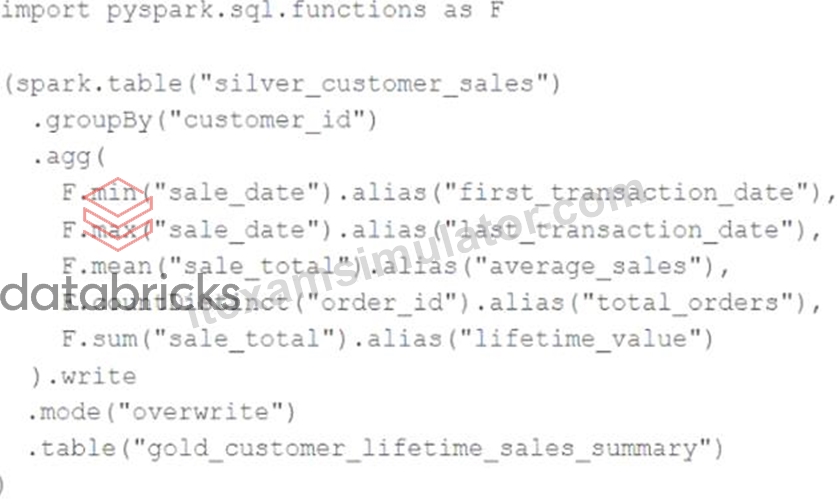
Assuming that this code produces logically correct results and the data in the source table has been de-duplicated and validated, which statement describes what will occur when this code is executed?
- A. The gold_customer_lifetime_sales_summary table will be overwritten by aggregated values calculated from all records in the silver_customer_sales table as a batch job.
- B. An incremental job will leverage running information in the state store to update aggregate values in the gold_customer_lifetime_sales_summary table.
- C. The silver_customer_sales table will be overwritten by aggregated values calculated from all records in the gold_customer_lifetime_sales_summary table as a batch job.
- D. A batch job will update the gold_customer_lifetime_sales_summary table, replacing only those rows that have different values than the current version of the table, using customer_id as the primary key.
- E. An incremental job will detect if new rows have been written to the silver_customer_sales table; if new rows are detected, all aggregates will be recalculated and used to overwrite the gold_customer_lifetime_sales_summary table.
Answer: A
Explanation:
This code is using the pyspark.sql.functions library to group the silver_customer_sales table by customer_id and then aggregate the data using the minimum sale date, maximum sale total, and sum of distinct order ids.
The resulting aggregated data is then written to the gold_customer_lifetime_sales_summary table, overwriting any existing data in that table. This is a batch job that does not use any incremental or streaming logic, and does not perform any merge or update operations. Therefore, the code will overwrite the gold table with the aggregated values from the silver table every time it is executed. References:
* https://docs.databricks.com/spark/latest/dataframes-datasets/introduction-to-dataframes-python.html
* https://docs.databricks.com/spark/latest/dataframes-datasets/transforming-data-with-dataframes.html
* https://docs.databricks.com/spark/latest/dataframes-datasets/aggregating-data-with-dataframes.html
NEW QUESTION # 28
The viewupdatesrepresents an incremental batch of all newly ingested data to be inserted or updated in the customerstable.
The following logic is used to process these records.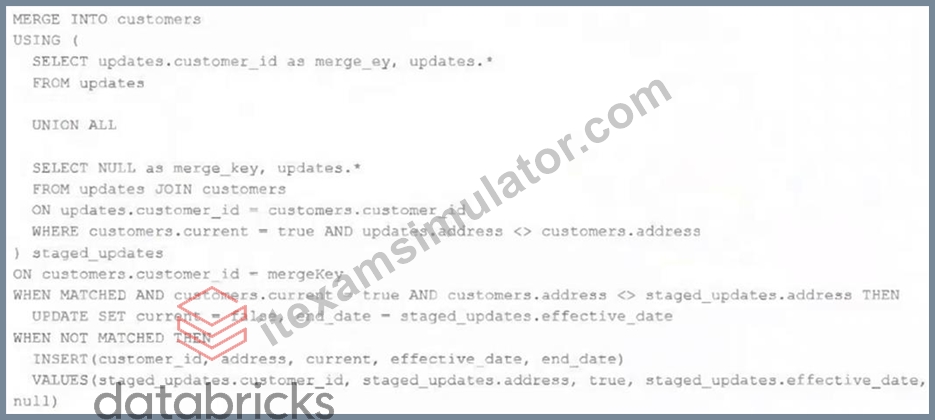
Which statement describes this implementation?
- A. The customers table is implemented as a Type 1 table; old values are overwritten by new values and no history is maintained.
- B. The customers table is implemented as a Type 2 table; old values are overwritten and new customers are appended.
- C. The customers table is implemented as a Type 2 table; old values are maintained but marked as no longer current and new values are inserted.
- D. The customers table is implemented as a Type 3 table; old values are maintained as a new column alongside the current value.
- E. The customers table is implemented as a Type 0 table; all writes are append only with no changes to existing values.
Answer: C
Explanation:
Explanation
The logic uses the MERGE INTO command to merge new records from the view updates into the table customers. The MERGE INTO command takes two arguments: a target table and a source table or view. The command also specifies a condition to match records between the target and the source, and a set of actions to perform when there is a match or not. In this case, the condition is to match records by customer_id, which is the primary key of the customers table. The actions are to update the existing record in the target with the new values from the source, and set the current_flag to false to indicate that the record is no longer current; and to insert a new record in the target with the new values from the source, and set the current_flag to true to indicate that the record is current. This means that old values are maintained but marked as no longer current and new values are inserted, which is the definition of a Type 2 table. Verified References: [Databricks Certified Data Engineer Professional], under "Delta Lake" section; Databricks Documentation, under "Merge Into (Delta Lake on Databricks)" section.
NEW QUESTION # 29
The research team has put together a funnel analysis query to monitor the customer traffic on the e-commerce platform, the query takes about 30 mins to run on a small SQL endpoint cluster with max scaling set to 1 cluster. What steps can be taken to improve the performance of the query?
- A. They can increase the cluster size anywhere from X small to 3XL to review the per-formance and select the size that meets the required SLA.
- B. They can increase the maximum bound of the SQL endpoint's scaling range anywhere from between 1 to 100 to review the performance and select the size that meets the re-quired SLA.
- C. They can turn on the Serverless feature for the SQL endpoint and change the Spot In-stance Policy from
"Cost optimized" to "Reliability Optimized." - D. They can turn on the Serverless feature for the SQL endpoint.
- E. They can turn off the Auto Stop feature for the SQL endpoint to more than 30 mins.
Answer: A
Explanation:
Explanation
The answer is, They can increase the cluster size anywhere from 2X-Small to 4XL(Scale Up) to review the performance and select the size that meets your SLA. If you are trying to improve the performance of a single query at a time having additional memory, additional worker nodes mean that more tasks can run in a cluster which will improve the performance of that query.
The question is looking to test your ability to know how to scale a SQL Endpoint(SQL Warehouse) and you have to look for cue words or need to understand if the queries are running sequentially or concurrently. if the queries are running sequentially then scale up(Size of the cluster from 2X-Small to 4X-Large) if the queries are running concurrently or with more users then scale out(add more clusters).
SQL Endpoint(SQL Warehouse) Overview: (Please read all of the below points and the below diagram to understand )
1.A SQL Warehouse should have at least one cluster
2.A cluster comprises one driver node and one or many worker nodes
3.No of worker nodes in a cluster is determined by the size of the cluster (2X -Small ->1 worker, X-Small ->2 workers.... up to 4X-Large -> 128 workers) this is called Scale Up
4.A single cluster irrespective of cluster size(2X-Smal.. to ...4XLarge) can only run 10 queries at any given time if a user submits 20 queries all at once to a warehouse with 3X-Large cluster size and cluster scaling (min
1, max1) while 10 queries will start running the remaining 10 queries wait in a queue for these 10 to finish.
5.Increasing the Warehouse cluster size can improve the performance of a query, example if a query runs for 1 minute in a 2X-Small warehouse size, it may run in 30 Seconds if we change the warehouse size to X-Small.
this is due to 2X-Small has 1 worker node and X-Small has 2 worker nodes so the query has more tasks and runs faster (note: this is an ideal case example, the scalability of a query performance depends on many factors, it can not always be linear)
6.A warehouse can have more than one cluster this is called Scale Out. If a warehouse is configured with X-Small cluster size with cluster scaling(Min1, Max 2) Databricks spins up an additional cluster if it detects queries are waiting in the queue, If a warehouse is configured to run 2 clusters(Min1, Max 2), and let's say a user submits 20 queries, 10 queriers will start running and holds the remaining in the queue and databricks will automatically start the second cluster and starts redirecting the 10 queries waiting in the queue to the second cluster.
7.A single query will not span more than one cluster, once a query is submitted to a cluster it will remain in that cluster until the query execution finishes irrespective of how many clusters are available to scale.
Please review the below diagram to understand the above concepts: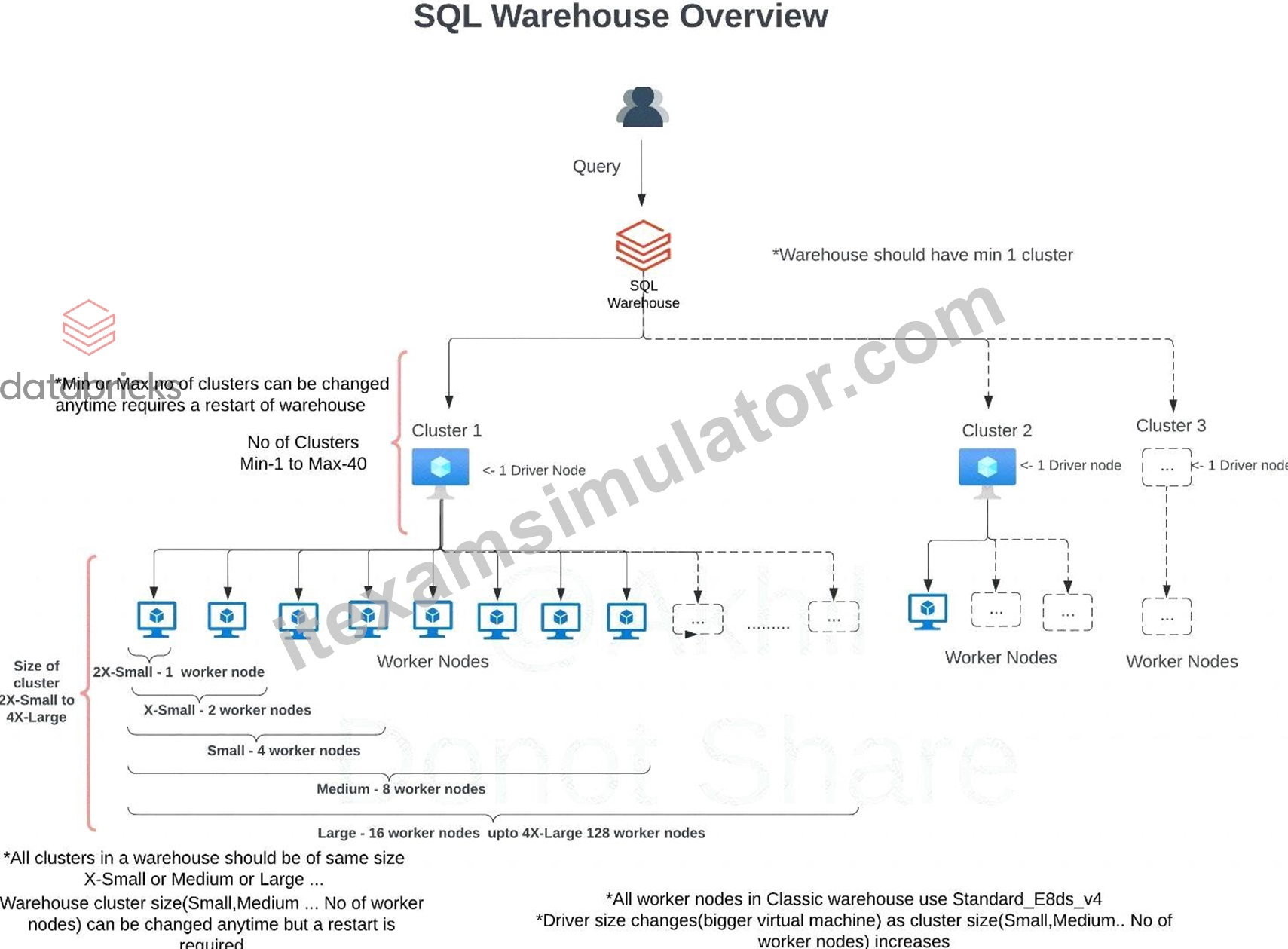
Scale-up-> Increase the size of the SQL endpoint, change cluster size from 2X-Small to up to 4X-Large If you are trying to improve the performance of a single query having additional memory, additional worker nodes and cores will result in more tasks running in the cluster will ultimately improve the performance.
During the warehouse creation or after, you have the ability to change the warehouse size (2X-Small....to
...4XLarge) to improve query performance and the maximize scaling range to add more clusters on a SQL Endpoint(SQL Warehouse) scale-out if you are changing an existing warehouse you may have to restart the warehouse to make the changes effective.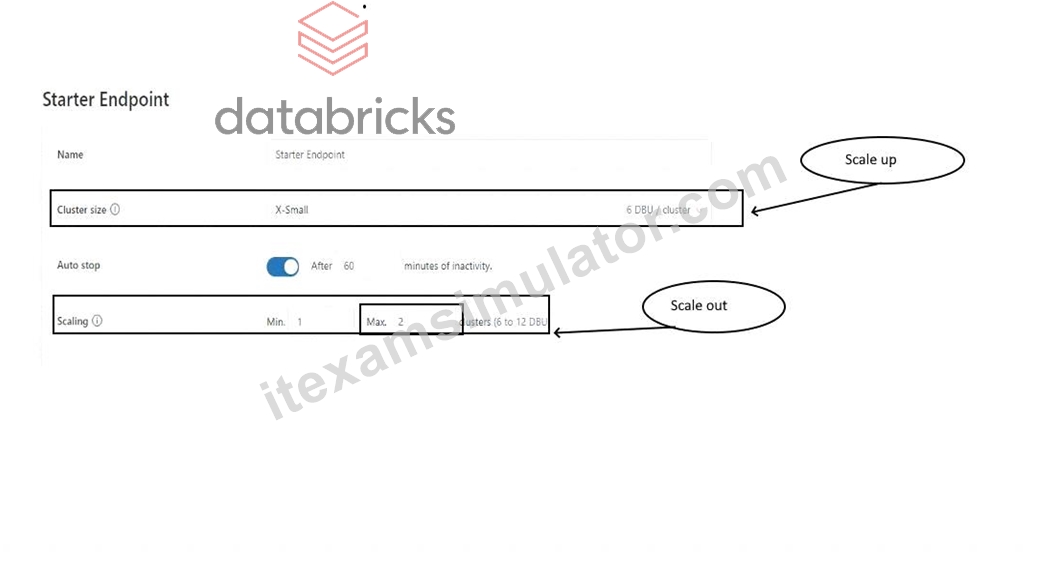
NEW QUESTION # 30
Which of the following statements can be used to test the functionality of code to test number of rows in the table equal to 10 in python?
row_count = spark.sql("select count(*) from table").collect()[0][0]
- A. assert (row_count = 10, "Row count did not match")
- B. assert if row_count == 10, "Row count did not match"
- C. assert row_count == 10, "Row count did not match"
- D. assert row_count = 10, "Row count did not match"
- E. assert if (row_count = 10, "Row count did not match")
Answer: C
Explanation:
Explanation
The answer is assert row_count == 10, "Row count did not match"
Review below documentation
NEW QUESTION # 31
The data engineering team maintains the following code:
Assuming that this code produces logically correct results and the data in the source tables has been de-duplicated and validated, which statement describes what will occur when this code is executed?
- A. An incremental job will detect if new rows have been written to any of the source tables; if new rows are detected, all results will be recalculated and used to overwrite the enriched_itemized_orders_by_account table.
- B. The enriched_itemized_orders_by_account table will be overwritten using the current valid version of data in each of the three tables referenced in the join logic.
- C. No computation will occur until enriched_itemized_orders_by_account is queried; upon query materialization, results will be calculated using the current valid version of data in each of the three tables referenced in the join logic.
- D. An incremental job will leverage information in the state store to identify unjoined rows in the source tables and write these rows to the enriched_iteinized_orders_by_account table.
- E. A batch job will update the enriched_itemized_orders_by_account table, replacing only those rows that have different values than the current version of the table, using accountID as the primary key.
Answer: B
Explanation:
This is the correct answer because it describes what will occur when this code is executed. The code uses three Delta Lake tables as input sources: accounts, orders, and order_items. These tables are joined together using SQL queries to create a view called new_enriched_itemized_orders_by_account, which contains information about each order item and its associated account details. Then, the code uses write.format("delta").mode("overwrite") to overwrite a target table called enriched_itemized_orders_by_account using the data from the view. This means that every time this code is executed, it will replace all existing data in the target table with new data based on the current valid version of data in each of the three input tables. Verified References: [Databricks Certified Data Engineer Professional], under "Delta Lake" section; Databricks Documentation, under "Write to Delta tables" section.
NEW QUESTION # 32
Consider flipping a coin for which the probability of heads is p, where p is unknown, and our goa is to
estimate p. The obvious approach is to count how many times the coin came up heads and divide by the total
number of coin flips. If we flip the coin 1000 times and it comes up heads 367 times, it is very reasonable to
estimate p as approximately 0.367. However, suppose we flip the coin only twice and we get heads both times.
Is it reasonable to estimate p as 1.0? Intuitively, given that we only flipped the coin twice, it seems a bit
rash to conclude that the coin will always come up heads, and____________is a way of avoiding such rash
conclusions.
- A. Logistic Regression
- B. Linear Regression
- C. Laplace Smoothing
- D. Naive Bayes
Answer: C
Explanation:
Explanation
Smooth the estimates:consider flipping a coin for which the probability of heads is p, where p is unknown, and
our goal is to estimate p. The obvious approach is to count how many times the coin came up heads and divide
by the total number of coin flips. If we flip the coin 1000 times and it comes up heads 367 times, it is very
reasonable to estimate p as approximately 0.367. However, suppose we flip the coin only twice and we get
heads both times. Is it reasonable to estimate p as 1.0? Intuitively, given that we only flipped the coin twice, it
seems a bit rash to conclude that the coin will always come up heads, and smoothing is a way of avoiding such
rash conclusions. A simple smoothing method, called Laplace smoothing (or Laplace's law of succession or
add-one smoothing in R&N), is to estimate p by (one plus the number of heads) / (two plus the total number of
flips). Said differently, if we are keeping count of the number of heads and the number of tails, this rule is
equivalent to starting each of our counts at one, rather than zero. Another advantage of Laplace smoothing is
that it avoids estimating any probabilities to be zero, even for events never observed in the data. Laplace
add-one smoothing now assigns too much probability to unseen words
NEW QUESTION # 33
Which of the following python statements can be used to replace the schema name and table name in the query?
- A. 1.table_name = "sales"
2.query = f"select * from {schema_name}.{table_name}" - B. 1.table_name = "sales"
2.query = "select * from {schema_name}.{table_name}" - C. 1.table_name = "sales"
2.schema_name = "bronze"
3.query = f"select * from schema_name.table_name" - D. 1.table_name = "sales"
2.query = f"select * from + schema_name +"."+table_name"
Answer: A
Explanation:
Explanation
The answer is
1.table_name = "sales"
2.query = f"select * from {schema_name}.{table_name}"
It is always best to use f strings to replace python variables, rather than using string concatenation.
NEW QUESTION # 34
Which statement describes the correct use of pyspark.sql.functions.broadcast?
- A. It marks a column as having low enough cardinality to properly map distinct values to available partitions, allowing a broadcast join.
- B. It marks a column as small enough to store in memory on all executors, allowing a broadcast join.
- C. It caches a copy of the indicated table on attached storage volumes for all active clusters within a Databricks workspace.
- D. It caches a copy of the indicated table on all nodes in the cluster for use in all future queries during the cluster lifetime.
- E. It marks a DataFrame as small enough to store in memory on all executors, allowing a broadcast join.
Answer: E
Explanation:
https://spark.apache.org/docs/3.1.3/api/python/reference/api/pyspark.sql.functions.broadcast.html The broadcast function in PySpark is used in the context of joins. When you mark a DataFrame with broadcast, Spark tries to send this DataFrame to all worker nodes so that it can be joined with another DataFrame without shuffling the larger DataFrame across the nodes. This is particularly beneficial when the DataFrame is small enough to fit into the memory of each node. It helps to optimize the join process by reducing the amount of data that needs to be shuffled across the cluster, which can be a very expensive operation in terms of computation and time.
Thepyspark.sql.functions.broadcastfunction in PySpark is used to hint to Spark that a DataFrame is small enough to be broadcast to all worker nodes in the cluster. When this hint is applied, Spark can perform a broadcast join, where the smaller DataFrame is sent to each executor only once and joined with the larger DataFrame on each executor. This can significantly reduce the amount of data shuffled across the network and can improve the performance of the join operation.
In a broadcast join, the entire smaller DataFrame is sent to each executor, not just a specific column or a cached version on attached storage. This function is particularly useful when one of the DataFrames in a join operation is much smaller than the other, and can fit comfortably in the memory of each executor node.
References:
* Databricks Documentation on Broadcast Joins: Databricks Broadcast Join Guide
* PySpark API Reference: pyspark.sql.functions.broadcast
NEW QUESTION # 35
How do you check the location of an existing schema in Delta Lake?
- A. Run SQL command SHOW LOCATION schema_name
- B. Check unity catalog UI
- C. Use Data explorer
- D. Run SQL command DESCRIBE SCHEMA EXTENDED schema_name
E Schemas are internally in-store external hive meta stores like MySQL or SQL Server
Answer: D
Explanation:
Explanation
Here is an example of how it looks
Graphical user interface, text, application, email Description automatically generated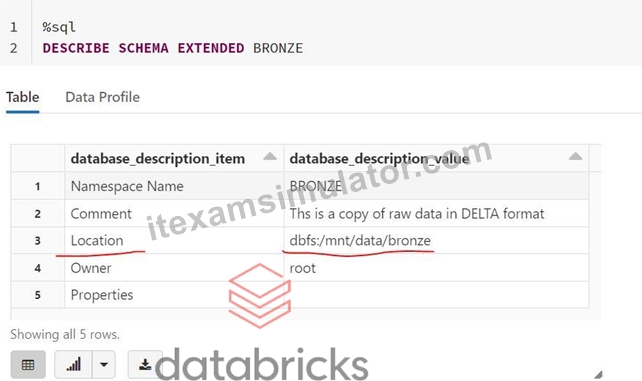
NEW QUESTION # 36
Which statement describes integration testing?
- A. Requires an automated testing framework
- B. Validates an application use case
- C. Validates behavior of individual elements of your application
- D. Validates interactions between subsystems of your application
- E. Requires manual intervention
Answer: D
Explanation:
Explanation
This is the correct answer because it describes integration testing. Integration testing is a type of testing that validates interactions between subsystems of your application, such as modules, components, or services.
Integration testing ensures that the subsystems work together as expected and produce the correct outputs or results. Integration testing can be done at different levels of granularity, such as component integration testing, system integration testing, or end-to-end testing. Integration testing can help detect errors or bugs that may not be found by unit testing, which only validates behavior of individual elements of your application. Verified References: [Databricks Certified Data Engineer Professional], under "Testing" section; Databricks Documentation, under "Integration testing" section.
NEW QUESTION # 37
The security team is exploring whether or not the Databricks secrets module can be leveraged for connecting to an external database.
After testing the code with all Python variables being defined with strings, they upload the password to the secrets module and configure the correct permissions for the currently active user. They then modify their code to the following (leaving all other variables unchanged).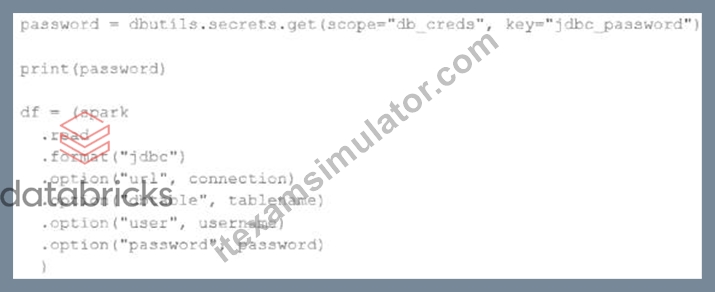
Which statement describes what will happen when the above code is executed?
- A. An interactive input box will appear in the notebook; if the right password is provided, the connection will succeed and the password will be printed in plain text.
- B. The connection to the external table will succeed; the string "redacted" will be printed.
- C. The connection to the external table will succeed; the string value of password will be printed in plain text.
- D. The connection to the external table will fail; the string "redacted" will be printed.
- E. An interactive input box will appear in the notebook; if the right password is provided, the connection will succeed and the encoded password will be saved to DBFS.
Answer: B
Explanation:
This is the correct answer because the code is using the dbutils.secrets.get method to retrieve the password from the secrets module and store it in a variable. The secrets module allows users to securely store and access sensitive information such as passwords, tokens, or API keys. The connection to the external table will succeed because the password variable will contain the actual password value. However, when printing the password variable, the string "redacted" will be displayed instead of the plain text password, as a security measure to prevent exposing sensitive information in notebooks. Verified References: [Databricks Certified Data Engineer Professional], under "Security & Governance" section; Databricks Documentation, under
"Secrets" section.
NEW QUESTION # 38
The data architect has mandated that all tables in the Lakehouse should be configured as external Delta Lake tables.
Which approach will ensure that this requirement is met?
- A. Whenever a database is being created, make sure that the location keyword is used
- B. Whenever a table is being created, make sure that the location keyword is used.
- C. When configuring an external data warehouse for all table storage. leverage Databricks for all ELT.
- D. When tables are created, make sure that the external keyword is used in the create table statement.
- E. When the workspace is being configured, make sure that external cloud object storage has been mounted.
Answer: B
Explanation:
This is the correct answer because it ensures that this requirement is met. The requirement is that all tables in the Lakehouse should be configured as external Delta Lake tables. An external table is a table that is stored outside of the default warehouse directory and whose metadata is not managed by Databricks. An external table can be created by using the location keyword to specify the path to an existing directory in a cloud storage system, such as DBFS or S3. By creating external tables, the data engineering team can avoid losing data if they drop or overwrite the table, as well as leverage existing data without moving or copying it.
Verified References: [Databricks Certified Data Engineer Professional], under "Delta Lake" section; Databricks Documentation, under "Create an external table" section.
NEW QUESTION # 39
A Delta Live Table pipeline includes two datasets defined using STREAMING LIVE TABLE.
Three datasets are defined against Delta Lake table sources using LIVE TABLE . The table is configured to
run in Development mode using the Triggered Pipeline Mode.
Assuming previously unprocessed data exists and all definitions are valid, what is the expected outcome after
clicking Start to update the pipeline?
- A. All datasets will be updated at set intervals until the pipeline is shut down. The compute resources will
be deployed for the update and terminated when the pipeline is stopped - B. All datasets will be updated once and the pipeline will shut down. The compute resources will be
terminated - C. All datasets will be updated at set intervals until the pipeline is shut down. The compute resources will
persist after the pipeline is stopped to allow for additional testing - D. All datasets will be updated once and the pipeline will shut down. The compute resources will persist to
allow for additional testing - E. All datasets will be updated continuously and the pipeline will not shut down. The compute resources
will persist with the pipeline
Answer: D
NEW QUESTION # 40
Which of the following statement is true about Databricks repos?
- A. A workspace can only have one instance of git integration
- B. You can approve the pull request if you are the owner of Databricks repos
- C. You cannot create a new branch in Databricks repos
- D. Databricks repos allow you to comment and commit code changes and push them to a remote branch
- E. Databricks Repos and Notebook versioning are the same features
Answer: D
Explanation:
Explanation
See below diagram to understand the role Databricks Repos and Git provider plays when building a CI/CD workdlow.
All the steps highlighted in yellow can be done Databricks Repo, all the steps highlighted in Gray are done in a git provider like Github or Azure Devops Diagram Description automatically generated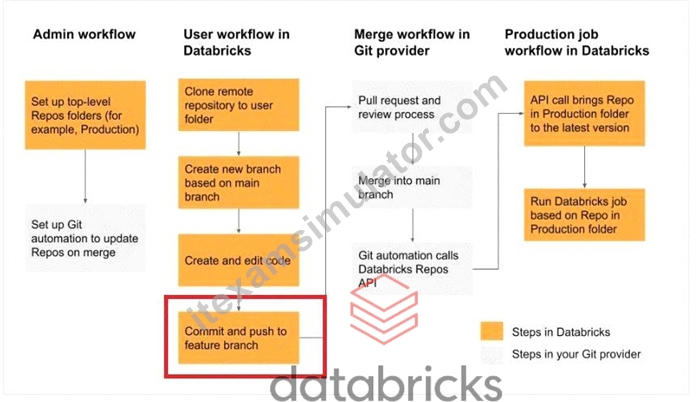
NEW QUESTION # 41
Each configuration below is identical to the extent that each cluster has 400 GB total of RAM, 160 total cores and only one Executor per VM.
Given a job with at least one wide transformation, which of the following cluster configurations will result in maximum performance?
- A. * Total VMs: 8
* 50 GB per Executor
* 20 Cores / Executor - B. * Total VMs:2
* 200 GB per Executor
* 80 Cores / Executor - C. * Total VMs: 4
* 100 GB per Executor
* 40 Cores/Executor - D. * Total VMs; 1
* 400 GB per Executor
* 160 Cores / Executor
Answer: A
Explanation:
Explanation
This is the correct answer because it is the cluster configuration that will result in maximum performance for a job with at least one wide transformation. A wide transformation is a type of transformation that requires shuffling data across partitions, such as join, groupBy, or orderBy. Shuffling can be expensive and time-consuming, especially if there are too many or too few partitions. Therefore, it is important to choose a cluster configuration that can balance the trade-off between parallelism and network overhead. In this case, having 8 VMs with 50 GB per executor and 20 cores per executor will create 8 partitions, each with enough memory and CPU resources to handle the shuffling efficiently. Having fewer VMs with more memory and cores per executor will create fewer partitions, which will reduce parallelism and increase the size of each shuffle block. Having more VMs with less memory and cores per executor will create more partitions, which will increase parallelism but also increase the network overhead and the number of shuffle files. Verified References: [Databricks Certified Data Engineer Professional], under "Performance Tuning" section; Databricks Documentation, under "Cluster configurations" section.
NEW QUESTION # 42
A data ingestion task requires a one-TB JSON dataset to be written out to Parquet with a target part-file size of
512 MB. Because Parquet is being used instead of Delta Lake, built-in file-sizing features such as Auto-Optimize & Auto-Compaction cannot be used.
Which strategy will yield the best performance without shuffling data?
- A. Ingest the data, execute the narrow transformations, repartition to 2,048 partitions (1TB*
1024*1024/512), and then write to parquet. - B. Set spark.sql.files.maxPartitionBytes to 512 MB, ingest the data, execute the narrow transformations, and then write to parquet.
- C. Set spark.sql.shuffle.partitions to 512, ingest the data, execute the narrow transformations, and then write to parquet.
- D. Set spark.sql.adaptive.advisoryPartitionSizeInBytes to 512 MB bytes, ingest the data, execute the narrow transformations, coalesce to 2,048 partitions (1TB*1024*1024/512), and then write to parquet.
- E. Set spark.sql.shuffle.partitions to 2,048 partitions (1TB*1024*1024/512), ingest the data, execute the narrow transformations, optimize the data by sorting it (which automatically repartitions the data), and then write to parquet.
Answer: E
Explanation:
The key to efficiently converting a large JSON dataset to Parquet files of a specific size without shuffling data lies in controlling the size of the output files directly.
* Settingspark.sql.files.maxPartitionBytesto 512 MB configures Spark to process data in chunks of 512 MB. This setting directly influences the size of the part-files in the output, aligning with the target file size.
* Narrow transformations (which do not involve shuffling data across partitions) can then be applied to this data.
* Writing the data out to Parquet will result in files that are approximately the size specified by spark.sql.files.maxPartitionBytes, in this case, 512 MB.
* The other options involve unnecessary shuffles or repartitions (B, C, D) or an incorrect setting for this specific requirement (E).
References:
* Apache Spark Documentation: Configuration - spark.sql.files.maxPartitionBytes
* Databricks Documentation on Data Sources: Databricks Data Sources Guide
NEW QUESTION # 43
Although the Databricks Utilities Secrets module provides tools to store sensitive credentials and avoid accidentally displaying them in plain text users should still be careful with which credentials are stored here and which users have access to using these secrets.
Which statement describes a limitation of Databricks Secrets?
- A. The Databricks REST API can be used to list secrets in plain text if the personal access token has proper credentials.
- B. Secrets are stored in an administrators-only table within the Hive Metastore; database administrators have permission to query this table by default.
- C. Iterating through a stored secret and printing each character will display secret contents in plain text.
- D. Because the SHA256 hash is used to obfuscate stored secrets, reversing this hash will display the value in plain text.
- E. Account administrators can see all secrets in plain text by loggingon to the Databricks Accounts console.
Answer: A
Explanation:
Explanation
This is the correct answer because it describes a limitation of Databricks Secrets. Databricks Secrets is a module that provides tools to store sensitive credentials and avoid accidentally displaying them in plain text.
Databricks Secrets allows creating secret scopes, which are collections of secrets that can be accessed by users or groups. Databricks Secrets also allows creating and managing secrets using the Databricks CLI or the Databricks REST API. However, a limitation of Databricks Secrets is that the Databricks REST API can be used to list secrets in plain text if the personal access token has proper credentials. Therefore, users should still be careful with which credentials are stored in Databricks Secrets and which users have access to using these secrets. Verified References: [Databricks Certified Data Engineer Professional], under "Databricks Workspace" section; Databricks Documentation, under "List secrets" section.
NEW QUESTION # 44
The current ELT pipeline is receiving data from the operations team once a day so you had setup an AUTO LOADER process to run once a day using trigger (Once = True) and scheduled a job to run once a day, operations team recently rolled out a new feature that allows them to send data every 1 min, what changes do you need to make to AUTO LOADER to process the data every 1 min.
- A. Enable stream processing
- B. Change AUTO LOADER trigger to ("1 minute")
- C. Change AUTO LOADER trigger to .trigger(ProcessingTime = "1 minute")
- D. Convert AUTO LOADER to structured streaming
- E. Setup a job cluster run the notebook once a minute
Answer: C
NEW QUESTION # 45
The data engineering team has configured a job to process customer requests to be forgotten (have their data deleted). All user data that needs to be deleted is stored in Delta Lake tables using default table settings.
The team has decided to process all deletions from the previous week as a batch job at 1am each Sunday. The total duration of this job is less than one hour. Every Monday at 3am, a batch job executes a series ofVACUUMcommands on all Delta Lake tables throughout the organization.
The compliance officer has recently learned about Delta Lake's time travel functionality. They are concerned that this might allow continued access to deleted data.
Assuming all delete logic is correctly implemented, which statement correctly addresses this concern?
- A. Because the default data retention threshold is 7 days, data files containing deleted records will be retained until the vacuum job is run 8 days later.
- B. Because the vacuum command permanently deletes all files containing deleted records, deleted records may be accessible with time travel for around 24 hours.
- C. Because Delta Lake's delete statements have ACID guarantees, deleted records will be permanently purged from all storage systems as soon as a delete job completes.
- D. Because the default data retention threshold is 24 hours, data files containing deleted records will be retained until the vacuum job is run the following day.
- E. Because Delta Lake time travel provides full access to the entire history of a table, deleted records can always be recreated by users with full admin privileges.
Answer: A
Explanation:
Explanation
https://learn.microsoft.com/en-us/azure/databricks/delta/vacuum
NEW QUESTION # 46
The data science team has created and logged a production model using MLflow. The following code correctly imports and applies the production model to output the predictions as a new DataFrame namedpredswith the schema "customer_id LONG, predictions DOUBLE, date DATE".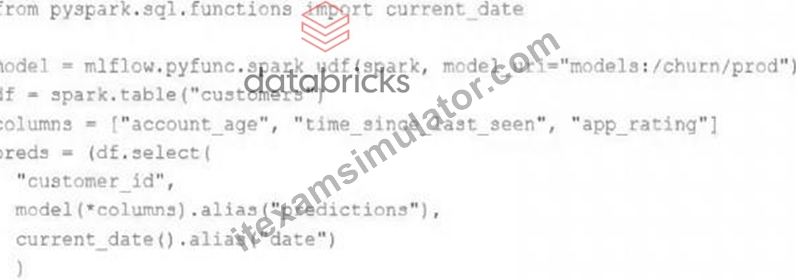
The data science team would like predictions saved to a Delta Lake table with the ability to compare all predictions across time. Churn predictions will be made at most once per day.
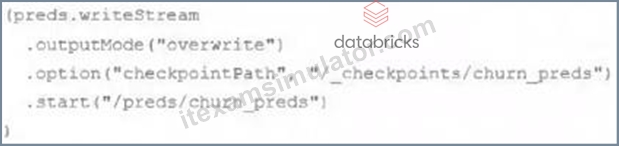
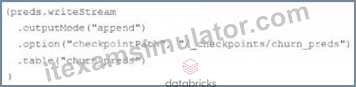
Which code block accomplishes this task while minimizing potential compute costs?
- A. preds.write.format("delta").save("/preds/churn_preds")
- B. preds.write.mode("append").saveAsTable("churn_preds")
- C.
- D.
- E.

Answer: C
Explanation:
Explanation
This is the correct answer because it will save the predictions to a Delta Lake table with the ability to compare all predictions across time. The code uses the mergeInto method to perform an upsert operation, which means it will insert new records or update existing records based on the customer_id and date columns. This way, the table will always contain the latest predictions for each customer and date, and also keep the history of previous predictions. The code also uses a new job cluster to run the job, which will minimize the compute costs as it will be created and terminated for each run. Verified References: [Databricks Certified Data Engineer Professional], under "Delta Lake" section; Databricks Documentation, under "Upsert into a table using merge" section.
NEW QUESTION # 47
......
Updated Databricks-Certified-Professional-Data-Engineer Dumps Questions For Databricks Exam: https://www.itexamsimulator.com/Databricks-Certified-Professional-Data-Engineer-brain-dumps.html
