

FCSS_SASE_AD-25 Free Update With 100% Exam Passing Guarantee [2026]
[Jan-2026] Verified Fortinet Exam Dumps with FCSS_SASE_AD-25 Exam Study Guide
Fortinet FCSS_SASE_AD-25 Exam Syllabus Topics:
| Topic | Details |
|---|---|
| Topic 1 |
|
| Topic 2 |
|
| Topic 3 |
|
| Topic 4 |
|
NEW QUESTION # 33
Which event log subtype captures FortiSASE SSL VPN user creation?
- A. Endpoint Events
- B. Administrator Events
- C. VPN Events
- D. User Events
Answer: D
Explanation:
The event log subtype that captures FortiSASE SSL VPN user creation is User Events . This subtype is specifically designed to log activities related to user management, such as creating, modifying, or deleting user accounts. When an SSL VPN user is created, it falls under this category because it involves adding a new user to the system.
Here's why the other options are incorrect:
A . Endpoint Events: These logs pertain to activities related to endpoint devices, such as device registration, compliance checks, or security posture assessments. SSL VPN user creation is unrelated to endpoint events.
B . VPN Events: These logs capture activities related to VPN connections, such as session establishment, termination, or errors. While SSL VPN usage generates VPN events, the creation of a user account itself is not logged under this subtype.
D . Administrator Events: These logs track actions performed by administrators, such as configuration changes or policy updates. While an administrator might create the SSL VPN user, the specific event of user creation is categorized under User Events, not Administrator Events.
Fortinet FCSS FortiSASE Documentation - Event Logging and Subtypes
FortiSASE Administration Guide - Monitoring and Logging
NEW QUESTION # 34
Refer to the exhibits.
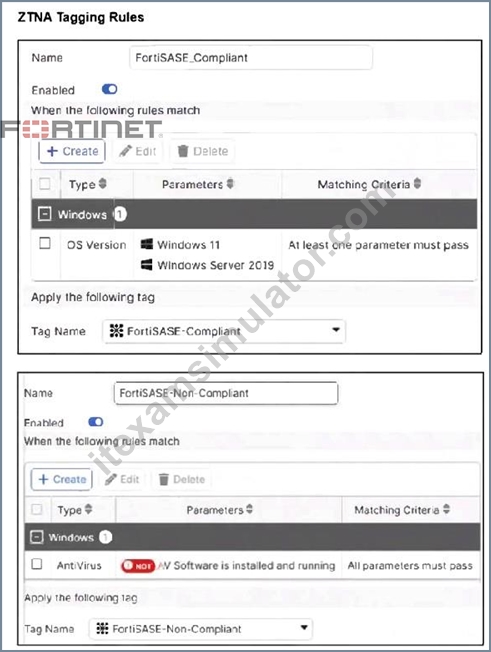
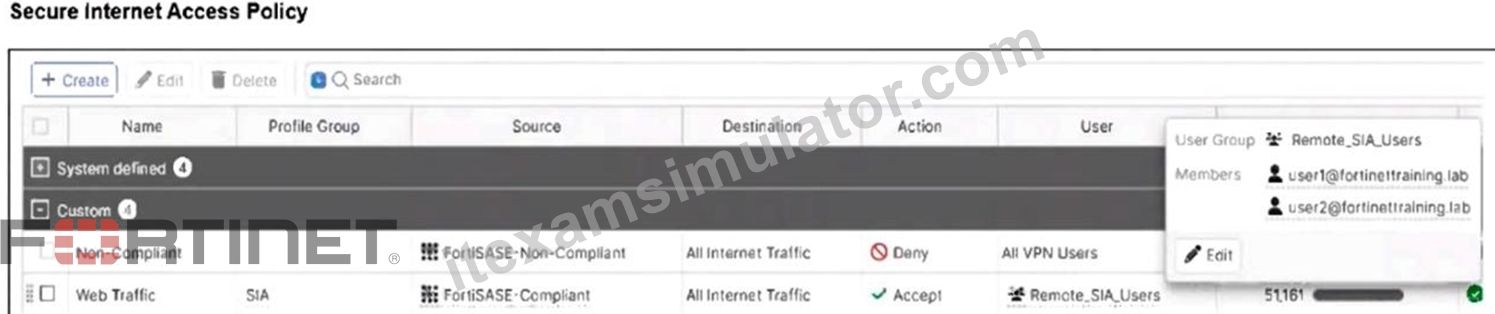
Jumpbox and Windows-AD are endpoints from the same remote location. Jumpbox can access the internet through FortiSASE, while Windows-AD can no longer access the internet.
Based on the information in the exhibits, which reason explains the outage on Windows-AD?
- A. The device posture for Windows-AD has changed.
- B. Windows-AD is excluded from FortiSASE management.
- C. The remote VPN user on Windows-AD no longer matches any VPN policy.
- D. The FortiClient version installed on Windows AD does not match the expected version on FortiSASE.
Answer: A
Explanation:
The Windows-AD endpoint now has both "FortiSASE-Compliant" and "FortiSASE-Non-Compliant" tags due to failing the antivirus software check. As a result, the Secure Internet Access Policy matches the "Non- Compliant" rule, which is set to Deny, causing the device to lose internet access.
NEW QUESTION # 35
Refer to the exhibit.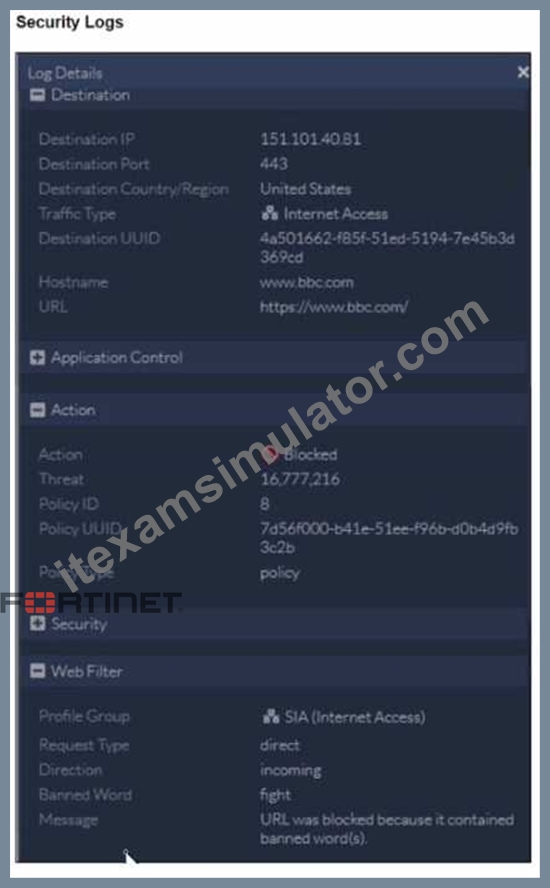
To allow access, which web tiller configuration must you change on FortiSASE?
- A. inline cloud access security broker (CASB) headers
- B. URL Filter
- C. FortiGuard category-based filter
- D. content filter
Answer: D
NEW QUESTION # 36
When accessing the FortiSASE portal for the first time, an administrator must select data center locations for which three FortiSASE components? (Choose three.)
- A. Points of presence
- B. Sandbox
- C. Endpoint management
- D. Identity & access management (IAM)
- E. Logging
Answer: B,C,E
Explanation:
When first accessing the FortiSASE portal, the administrator must select data center locations for endpoint management, logging, and sandbox services to ensure optimized performance and compliance with data residency requirements.
NEW QUESTION # 37
When you configure FortiSASE Secure Private Access (SPA) with SD-WAN integration, you must establish a routing adjacency between FortiSASE and the FortiGate SD-WAN hub. Which routing protocol must you use?
- A. EIGRP
- B. OSPF
- C. BGP
- D. IS-IS
Answer: C
Explanation:
When configuring FortiSASE Secure Private Access (SPA) with SD-WAN integration, establishing a routing adjacency between FortiSASE and the FortiGate SD-WAN hub requires the use of the Border Gateway Protocol (BGP).
BGP (Border Gateway Protocol):
BGP is widely used for establishing routing adjacencies between different networks, particularly in SD-WAN environments.
It provides scalability and flexibility in managing dynamic routing between FortiSASE and the FortiGate SD-WAN hub.
Routing Adjacency:
BGP enables the exchange of routing information between FortiSASE and the FortiGate SD-WAN hub.
This ensures optimal routing paths and efficient traffic management across the hybrid network.
FortiOS 7.2 Administration Guide: Provides information on configuring BGP for SD-WAN integration.
FortiSASE 23.2 Documentation: Details on setting up routing adjacencies using BGP for Secure Private Access with SD-WAN.
NEW QUESTION # 38
When viewing the daily summary report generated by FortiSASE, the administrator notices that the report contains very little data.
What is a possible explanation for this almost empty report?
- A. Log allowed traffic is set to Security Events for all policies.
- B. The web filter security profile is not set to Monitor.
- C. There are no security profile groups applied to all policies.
- D. Digital experience monitoring is not configured.
Answer: A
Explanation:
The issue of an almost empty daily summary report in FortiSASE can often be traced back to how logging is configured within the system. Specifically, if "Log Allowed Traffic" is set to "Security Events" for all policies, it means that only security-related events (such as threats or anomalies) are being logged, while normal, allowed traffic is not being recorded. Since most traffic in a typical network environment is allowed, this configuration would result in very little data being captured and subsequently reported in the daily summary.
Here's a breakdown of why the other options are less likely to be the cause:
B . There are no security profile groups applied to all policies: While applying security profiles is important for comprehensive protection, their absence does not directly affect the volume of data in reports unless specific logging settings are also misconfigured.
C . The web filter security profile is not set to Monitor: This option pertains specifically to web filtering activities. Even if web filtering is not set to monitor mode, other types of traffic and logs should still populate the report.
D . Digital experience monitoring is not configured: Digital Experience Monitoring (DEM) focuses on user experience metrics rather than general traffic logging. Its absence would not lead to an almost empty report.
To resolve this issue, administrators should review the logging settings across all policies and ensure that "Log Allowed Traffic" is appropriately configured to capture the necessary data for reporting purposes.
Fortinet FCSS FortiSASE Documentation - Reporting and Logging Best Practices FortiSASE Administration Guide - Configuring Logging Settings
NEW QUESTION # 39
Which two advantages does FortiSASE bring to businesses with microbranch offices that have FortiAP deployed for unmanaged devices? (Choose two.)
- A. It secures internet access both on and off the network.
- B. It uses zero trust network access (ZTNA) tags to perform device compliance checks.
- C. It simplifies management and provisioning.
- D. It eliminates the requirement for an on-premises firewall.
Answer: A,D
NEW QUESTION # 40
Which two statements describe a zero trust network access (ZTNA) private access use case? (Choose two.)
- A. The security posture of the device is secure.
- B. All FortiSASE user-based deployments are supported.
- C. All TCP-based applications are supported.
- D. Data center redundancy is offered.
Answer: A,C
Explanation:
Zero Trust Network Access (ZTNA) private access use cases focus on providing secure and controlled access to private applications without exposing them to the public internet. The following two statements accurately describe ZTNA private access use cases:
The security posture of the device is secure (Option A):
ZTNA enforces strict access controls based on the principle of least privilege. Before granting access to private applications, ZTNA evaluates the security posture of the device (e.g., whether it is patched, compliant, and free of malware). Only devices that meet the required security standards are granted access, ensuring that the device is secure before allowing private access.
All TCP-based applications are supported (Option C):
ZTNA supports all TCP-based applications, enabling secure access to a wide range of private applications, including legacy systems and custom-built applications. This flexibility makes ZTNA suitable for organizations with diverse application environments.
Here's why the other options are incorrect:
B . All FortiSASE user-based deployments are supported: While FortiSASE supports various deployment scenarios, not all user-based deployments are automatically compatible with ZTNA. Specific configurations and requirements must be met to enable ZTNA functionality.
D . Data center redundancy is offered: Data center redundancy is unrelated to ZTNA private access use cases. Redundancy typically pertains to infrastructure design and failover mechanisms, not access control methodologies like ZTNA.
Fortinet FCSS FortiSASE Documentation - ZTNA Private Access Overview
FortiSASE Administration Guide - ZTNA Deployment Best Practices
NEW QUESTION # 41
How can FortiView be utilized to enhance security posture within an organization?
- A. By broadcasting system updates
- B. By displaying ads relevant to the IT department
- C. By tracking the physical locations of network devices
- D. By providing detailed insights into application usage
Answer: D
NEW QUESTION # 42
Which FortiSASE feature ensures least-privileged user access to all applications?
- A. thin branch SASE extension
- B. zero trust network access (ZTNA)
- C. SD-WAN
- D. secure web gateway (SWG)
Answer: B
Explanation:
Zero Trust Network Access (ZTNA) is the FortiSASE feature that ensures least-privileged user access to all applications. ZTNA operates on the principle of "never trust, always verify," providing secure access based on the identity of users and devices, regardless of their location.
Zero Trust Network Access (ZTNA):
ZTNA ensures that only authenticated and authorized users and devices can access applications.
It applies the principle of least privilege by granting access only to the resources required by the user, minimizing the potential for unauthorized access.
Implementation:
ZTNA continuously verifies user and device trustworthiness and enforces granular access control policies.
This approach enhances security by reducing the attack surface and limiting lateral movement within the network.
FortiOS 7.2 Administration Guide: Provides detailed information on ZTNA and its role in ensuring least-privileged access.
FortiSASE 23.2 Documentation: Explains the implementation and benefits of ZTNA within the FortiSASE environment.
NEW QUESTION # 43
Which two components are part of onboarding a secure web gateway (SWG) endpoint? (Choose two)
- A. FortiClient installer
- B. proxy auto-configuration (PAC) file
- C. FortiSASE invitation code
- D. FortiSASE CA certificate
Answer: B,D
Explanation:
Onboarding a Secure Web Gateway (SWG) endpoint involves several components to ensure secure and effective integration with FortiSASE. Two key components are the FortiSASE CA certificate and the proxy auto-configuration (PAC) file.
FortiSASE CA Certificate:
The FortiSASE CA certificate is essential for establishing trust between the endpoint and the FortiSASE infrastructure.
It ensures that the endpoint can securely communicate with FortiSASE services and inspect SSL/TLS traffic.
Proxy Auto-Configuration (PAC) File:
The PAC file is used to configure the endpoint to direct web traffic through the FortiSASE proxy.
It provides instructions on how to route traffic, ensuring that all web requests are properly inspected and filtered by FortiSASE.
FortiOS 7.2 Administration Guide: Details on onboarding endpoints and configuring SWG.
FortiSASE 23.2 Documentation: Explains the components required for integrating endpoints with FortiSASE and the process for deploying the CA certificate and PAC file.
NEW QUESTION # 44
An organization wants to block all video and audio application traffic but grant access to videos from CNN Which application override action must you configure in the Application Control with Inline-CASB?
- A. Allow
- B. Pass
- C. Exempt
- D. Permit
Answer: A
Explanation:
(https://docs.fortinet.com/document/fortisase/24.4.75/sia-agent-based-deployment-guide/568255/configuring-application-control-profile
NEW QUESTION # 45
Refer to the exhibit.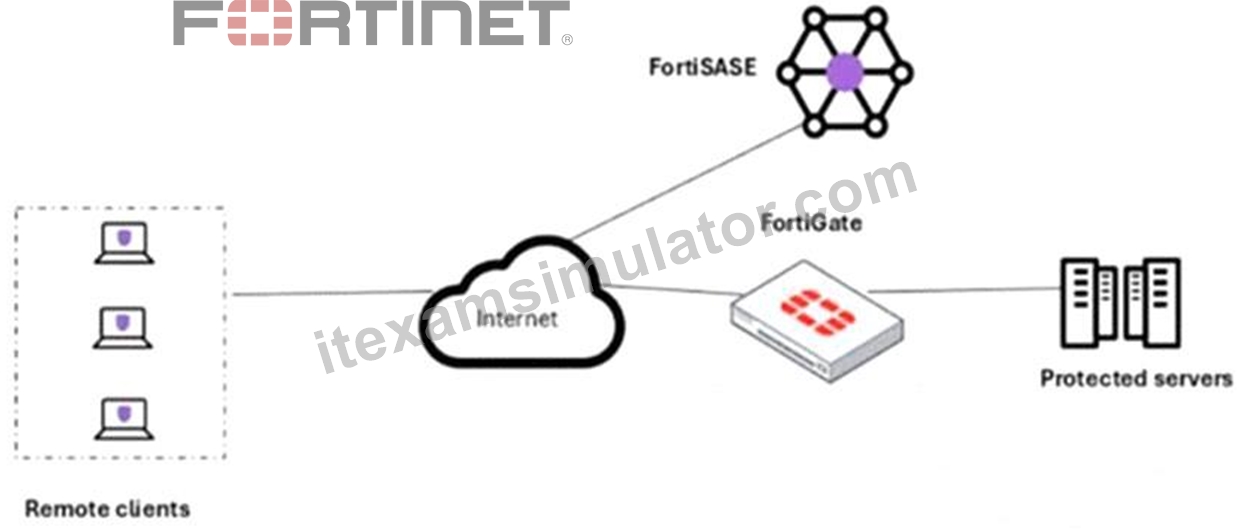
A customer needs to implement device posture checks for their remote endpoints while accessing the protected server. They also want the TCP traffic between the remote endpoints and the protected servers to be processed by FortiGate.
In this scenario, which two setups will achieve these requirements? (Choose two.)
- A. Configure ZTNA tags on FortiGate.
- B. Configure private access policies on FortiSASE with ZTNA.
- C. Configure FortiGate as a zero trust network access (ZTNA) access proxy.
- D. Configure ZTNA servers and ZTNA policies on FortiGate.
Answer: C,D
Explanation:
To enforce device posture checks and ensure that TCP traffic flows through FortiGate, the FortiGate must act as a ZTNA access proxy and host the ZTNA servers and policies. This setup allows posture validation via FortiSASE while routing traffic securely to protected servers through FortiGate.
NEW QUESTION # 46
A customer wants to upgrade their legacy on-premises proxy to a could-based proxy for a hybrid network. Which FortiSASE features would help the customer to achieve this outcome?
- A. zero trust network access (ZTNA) and next generation firewall (NGFW)
- B. SD-WAN and inline-CASB
- C. secure web gateway (SWG) and inline-CASB
- D. SD-WAN and NGFW
Answer: C
Explanation:
For a customer looking to upgrade their legacy on-premises proxy to a cloud-based proxy for a hybrid network, the combination of Secure Web Gateway (SWG) and Inline Cloud Access Security Broker (CASB) features in FortiSASE will provide the necessary capabilities.
Secure Web Gateway (SWG):
SWG provides comprehensive web security by inspecting and filtering web traffic to protect against web-based threats.
It ensures that all web traffic, whether originating from on-premises or remote locations, is inspected and secured by the cloud-based proxy.
Inline Cloud Access Security Broker (CASB):
CASB enhances security by providing visibility and control over cloud applications and services.
Inline CASB integrates with SWG to enforce security policies for cloud application usage, preventing unauthorized access and data leakage.
FortiOS 7.2 Administration Guide: Details on SWG and CASB features.
FortiSASE 23.2 Documentation: Explains how SWG and inline-CASB are used in cloud-based proxy solutions.
NEW QUESTION # 47
Which FortiOS command is used to verify the health of Zero Trust Network Access (ZTNA) policies in FortiSASE?
- A. diagnose debug application ztna
- B. diagnose ztna status
- C. get ztna policy-status
- D. get system ztna status
Answer: A
NEW QUESTION # 48
How can digital experience monitoring (DEM) on an endpoint assist in diagnosing connectivity and network issues?
- A. FortiSASE runs a netstat from the endpoint to the SaaS application to see if ports are open.
- B. FortiSASE runs a ping from the endpoint to calculate the TTL to the SaaS application.
- C. FortiSASE runs SNMP traps to the endpoint using the DEM agent to verify the SaaS application health status.
- D. FortiSASE runs a trace job on the endpoint using the DEM agent to the Software-as-a-Service (SaaS) application.
Answer: D
Explanation:
The Digital Experience Monitoring (DEM) agent on the endpoint performs a trace route to the SaaS application to measure latency, packet loss, and hop-by-hop performance. This helps diagnose where in the path connectivity or performance issues are occurring.
NEW QUESTION # 49
Refer to the exhibits.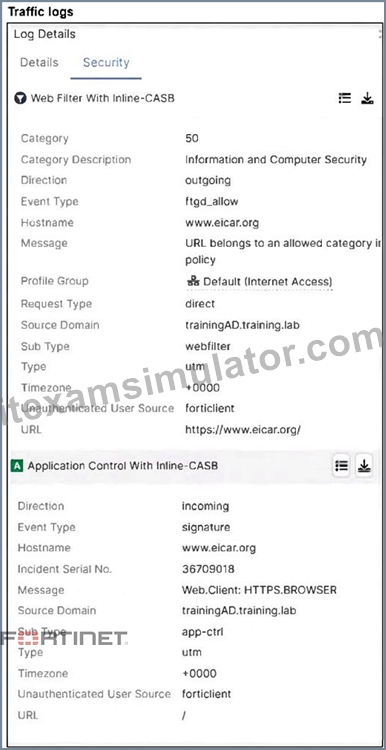
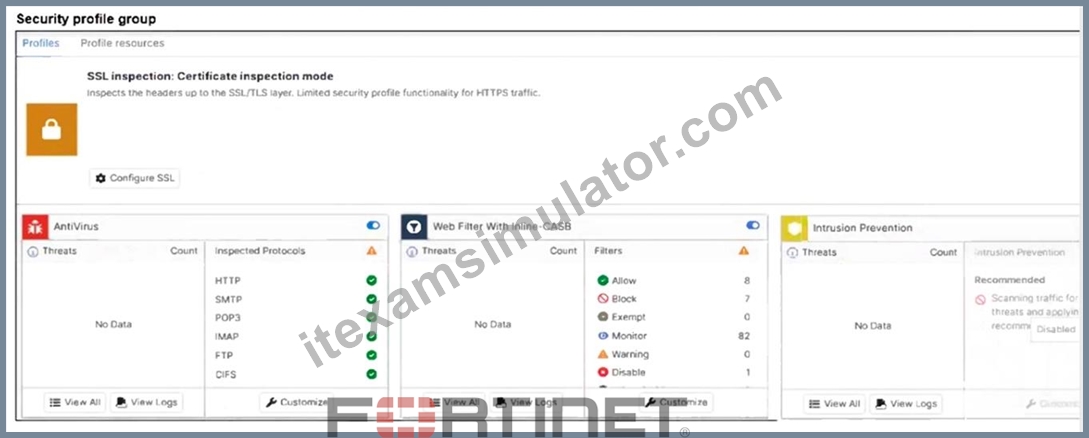
A FortiSASE administrator has configured an antivirus profile in the security profile group and applied it to the internet access policy. Remote users are still able to download the eicar.com-zip file from https://eicar.org.
Which configuration on FortiSASE is allowing users to perform the download?
- A. Web filter is allowing the URL.
- B. Intrusion prevention is disabled.
- C. Deep inspection is not enabled.
- D. Application control is exempting all the browser traffic.
Answer: C
Explanation:
The SSL inspection mode is set to certificate inspection, which only inspects SSL/TLS headers and does not allow full scanning of encrypted content. Without full (deep) inspection, the antivirus profile cannot scan or block malicious files (like eicar.com-zip) delivered over HTTPS, allowing the download to proceed.
NEW QUESTION # 50
Refer to the exhibits.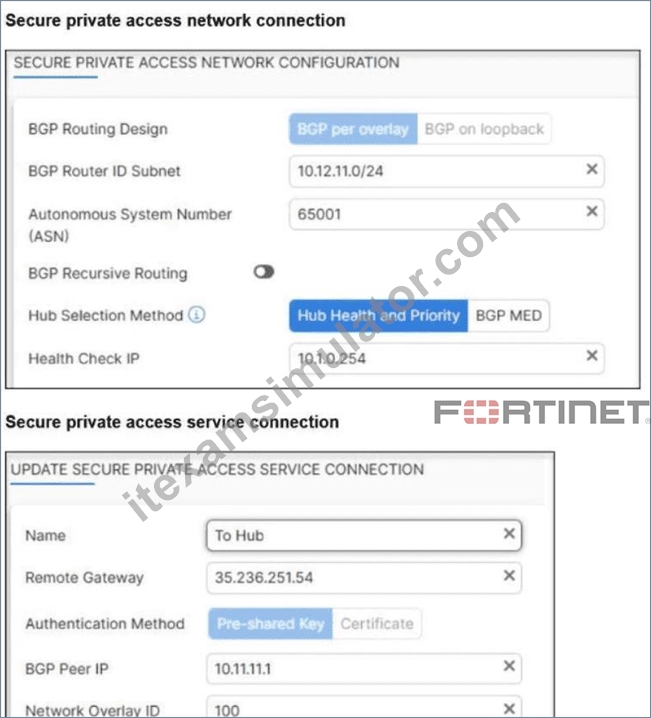
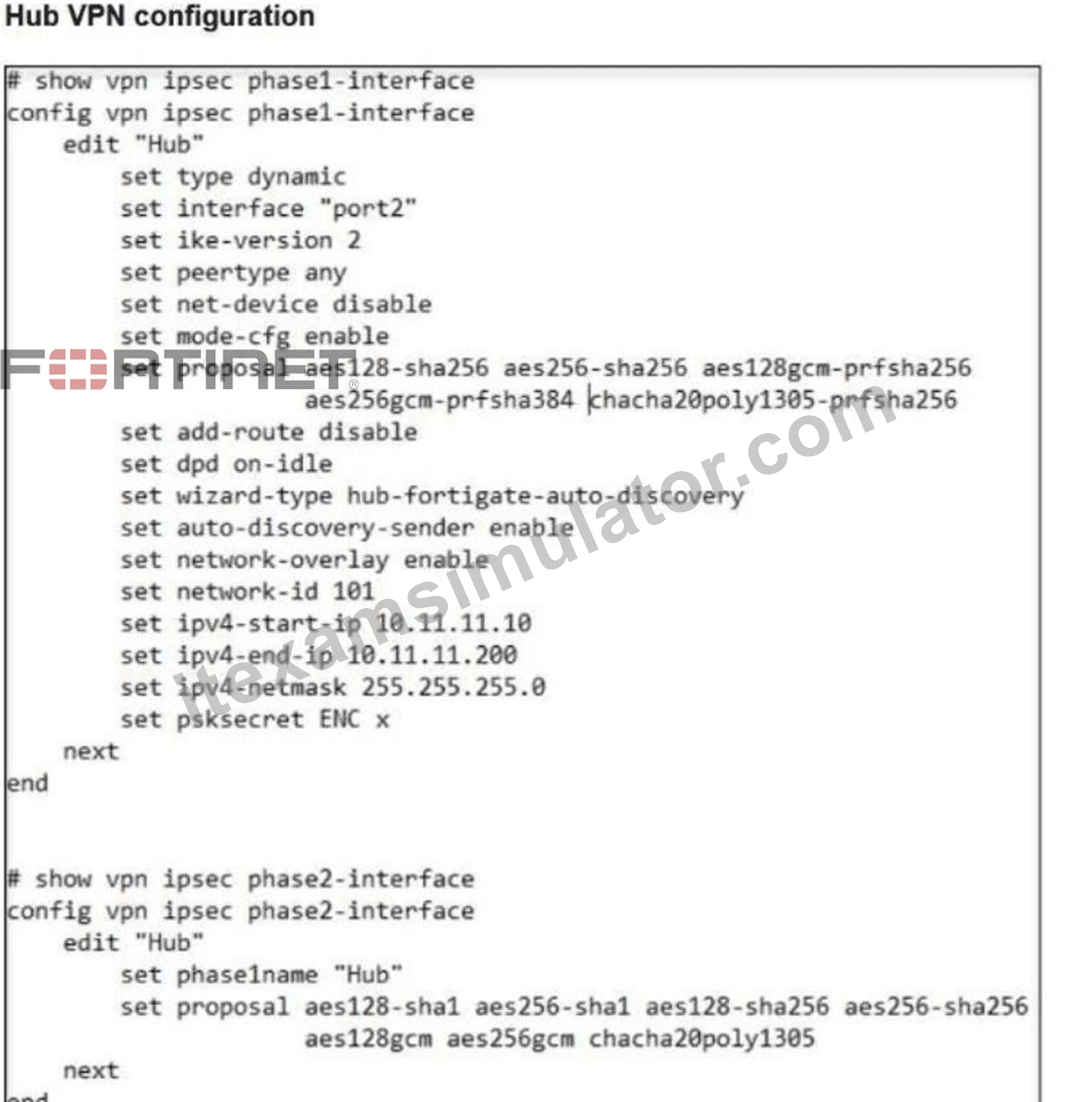
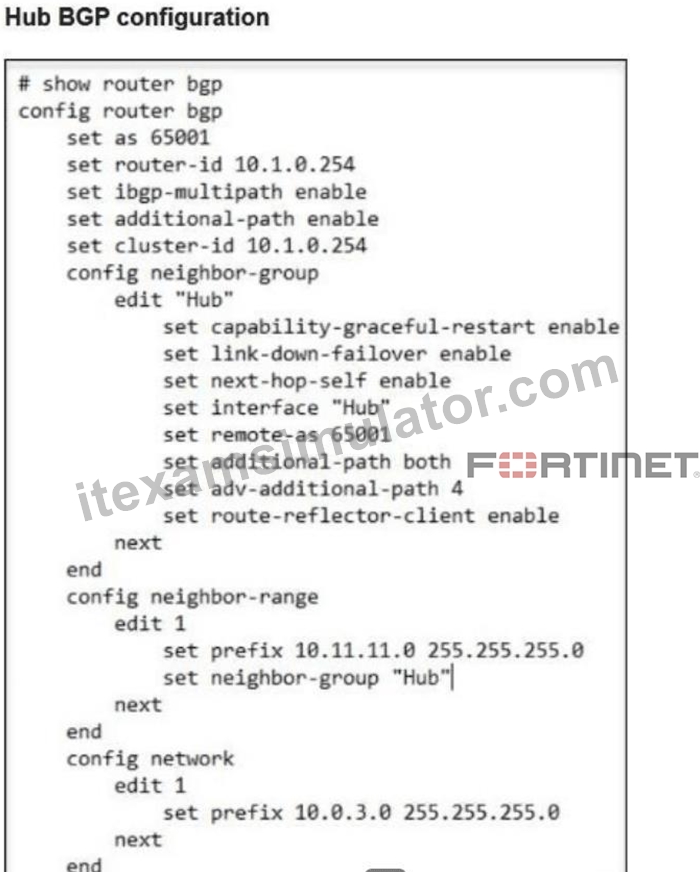
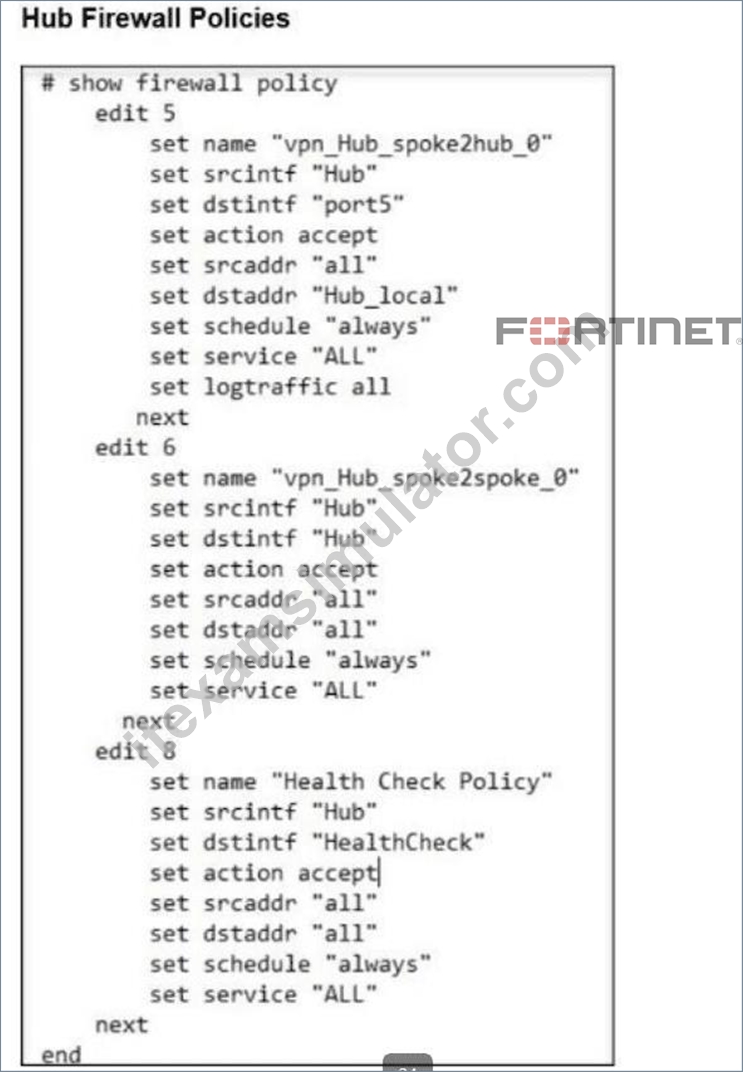
A FortiSASE administrator is trying to configure FortiSASE as a spoke to a FortiGate hub.
The VPN tunnel does not establish.
Which configuration needs to be modified to bring the tunnel up?
- A. The BGP router ID must match on the hub and FortiSASE.
- B. FortiSASE spoke devices do not support mode config.
- C. The network overlay ID must match on FortiSASE and the hub.
- D. Auto-discovery-sender must be disabled on IPsec phase1 settings.
Answer: C
Explanation:
Fortinet documentation makes clear that overlay IDs must be identical on hub and spoke for ADVPN to establish correctly:
"When configuring the root and downstream FortiGates the Fabric Overlay Orchestrator configures... IPsec overlay configuration (hub and spoke ADVPN tunnels)."
"The Fabric root will be the hub and any first-level downstream devices from the Fabric root will be spokes." In the scenario:
FortiSASE overlay ID = 100
FortiGate hub overlay ID = 101
Mismatch prevents tunnel establishment. Therefore, the fix is: B. The network overlay ID must match on FortiSASE and the hub.
NEW QUESTION # 51
Refer to the exhibit.
While reviewing the traffic logs, the FortiSASE administrator notices that the usernames are showing random characters.
Why are the usernames showing random characters?
- A. FortiSASE uses FortiClient unique identifiers for usernames.
- B. Log anonymization is turned on to hash usernames.
- C. Users are using a shared single sign-on SSO username.
- D. Special characters are used in usernames.
Answer: B
Explanation:
The usernames appear as random character strings because log anonymization is enabled in FortiSASE, which hashes sensitive user information such as usernames to protect privacy while still allowing log analysis.
NEW QUESTION # 52
Which statement best describes the Digital Experience Monitor (DEM) feature on FortiSASE?
- A. It can be used to request a detailed analysis of the endpoint from the FortiGuard team.
- B. It provides end-to-end network visibility from all the FortiSASE security PoPs to a specific SaaS application.
- C. It can help IT and security teams ensure consistent security monitoring for remote users.
- D. It requires a separate DEM agent to be downloaded from the FortiSASE portal and installed on the endpoint.
Answer: B
Explanation:
The Digital Experience Monitor (DEM) feature in FortiSASE is designed to provide end-to-end network visibility by monitoring the performance and health of connections between FortiSASE security Points of Presence (PoPs) and specific SaaS applications. This ensures that administrators can identify and troubleshoot issues related to latency, jitter, packet loss, and other network performance metrics that could impact user experience when accessing cloud-based services.
Here's why the other options are incorrect:
B . It can be used to request a detailed analysis of the endpoint from the FortiGuard team: This is incorrect because DEM focuses on network performance monitoring, not endpoint analysis. Endpoint analysis would typically involve tools like FortiClient or FortiEDR, not DEM.
C . It requires a separate DEM agent to be downloaded from the FortiSASE portal and installed on the endpoint: This is incorrect because DEM operates at the network level and does not require an additional agent to be installed on endpoints.
D . It can help IT and security teams ensure consistent security monitoring for remote users: While DEM indirectly supports security by ensuring optimal network performance, its primary purpose is to monitor and improve the digital experience rather than enforce security policies.
Fortinet FCSS FortiSASE Documentation - Digital Experience Monitoring Overview FortiSASE Administration Guide - Configuring DEM
NEW QUESTION # 53
......
Authentic Best resources for FCSS_SASE_AD-25 Online Practice Exam: https://www.itexamsimulator.com/FCSS_SASE_AD-25-brain-dumps.html
FCSS_SASE_AD-25 Test Engine Practice Exam: https://drive.google.com/open?id=1AE1DVYUuXcVDxQ-RP0a3cglsXB3q9fNP
