

Best Quality UiPath-ADPv1 Exam Questions UiPath Test To Gain Brilliante Result!
Preparations of UiPath-ADPv1 Exam 2026 UiPath Certified Professional - Developer Track Unlimited 206 Questions
NEW QUESTION # 58
How would you define a linear process in UiPath?
- A. The steps of the process are performed multiple times, but each time different data items are used.
- B. The steps of the process refer to the execution of steps in a sequential manner, where each subsequent step depends on the successful completion of the previous step.
- C. The process steps are performed only once. If the need is to process additional data, then the automation must execute again.
- D. The steps of the process repeat multiple times over different data items. However, the automation design is such that each repeatable part processes independently.
Answer: C
Explanation:
A linear process in UiPath is a type of process that is executed only once and does not involve any looping or branching logic. It is suitable for simple scenarios where the input data is fixed and the output is predictable.
A linear process can be designed using a Sequence or a Flowchart diagram, but it does not use any Flow Decision, Switch, While, Do While, or For Each activity. If the process needs to process additional data, then the automation must be executed again with the new data as input. References: Framework for linear process or single transaction, How to modify ReFramework to Linear Process, Workflow Design, Difference between Linear process and Transactional process
NEW QUESTION # 59
Based on the following exhibit, which output is displayed in the Output panel rt Step Out is clicked on the Debug ribbon tab of UlPath Studio?
- A. UiPath RPAAutomatlon
- B. Automation
- C. Automation RPAUiPath RPA
- D. UiPath RPA
Answer: A
NEW QUESTION # 60
What are the steps to publish a project from UiPath Studio?
Instructions: Drag the Description found on the "Left" and drop on the correct Step Sequence found on the
"Right".
Answer:
Explanation:
Explanation:
NEW QUESTION # 61
What functionality does the Step Out action offer when a developer Is reviewing a process during debugging, as shown in the exhibit?
- A. Re-executes the activity which threw an exception.
- B. Executes activities in the current container and then pauses the execution
- C. Steps out and stops current execution.
- D. Executes only one activity at a time and then pauses the execution
Answer: B
Explanation:
The "Step Out" action in UiPath Studio's debugging tools allows the developer to finish executing the current container (such as a sequence, loop, or workflow) and returns to the next higher level in the call stack.
Essentially, it continues the execution of activities within the current container without stepping into any invoked workflows or activities.
The correct functionality provided by the "Step Out" action is:
D: Executes activities in the current container and then pauses the execution after stepping out to the next higher level in the call stack.
NEW QUESTION # 62
A developer is building an automation which types text into a text file. The Activity Project Settings tor UI Automation Modern activities are set as follows:
The developer has configured the properties of a Type Into activity as follows:
What is the behavior of the Type Into activity when executing the workflow?
- A. The activity will remove a Single Line in Run mode and Multi Line in Debug mode.
- B. The activity will use only properties set in Activity Project Settings.
- C. The activity will remove Multi Line in Run mode and a Single Line in Debug mode.
- D. The activity will remove a Single Line in Run mode and in Debug mode.
Answer: A
NEW QUESTION # 63
How should the computation of the signature be done for client apps that receive Orchestrator requests and need to check their authenticity?
Instructions: Drag the Description found on the left and drop on the correct Step Sequence found on the right.
Answer:
Explanation:

NEW QUESTION # 64
On 10/04/2023 five Queue Items were added to a queue. What is the appropriate processing sequence for Queue Items based on their properties?
Instructions: Drag the Queue Item found on the "Left" and drop on the correct Process Sequence found on the
"Right".
Answer:
Explanation:
Explanation:
The processing sequence for queue items in UiPath Orchestrator is determined primarily by the deadline and priority of each item. Items with an earlier deadline are processed first. If multiple items have the same deadline, then priority determines the order: High, Normal, then Low.
Following this logic, the processing sequence would be:
1st: Deadline = 10/04/2023 Priority = LowSince this is the only item with the deadline of the current day (assuming today is 10/04/2023), it should be processed first regardless of its priority.
2nd: No deadline Priority = HighAlthough this item has no deadline, its high priority places it next in the sequence after items with a deadline for the current day.
3rd: Deadline = 10/05/2023 Priority = HighThis item is next due to its combination of an imminent deadline and high priority.
4th: Deadline = 10/05/2023 Priority = NormalThis item has the same deadline as the third but a lower priority, so it comes next.
5th: Deadline = 10/06/2023 Priority = HighThis item, while high priority, has the latest deadline, so it is processed last.
So the order would be:
1st: Deadline = 10/04/2023 Priority = Low2nd: No deadline Priority = High3rd: Deadline = 10/05/2023 Priority = High4th: Deadline = 10/05/2023 Priority = Normal5th: Deadline = 10/06/2023 Priority = High
NEW QUESTION # 65
What is the default polling interval set for an event trigger?
- A. 10 minutes
- B. 15 minutes
- C. 1 minute
- D. 5 minutes
Answer: D
Explanation:
When you create a new connection and set up an event trigger on that connection, the default polling interval is set to 5 minutes. This means that the event trigger checks for new object events every 5 minutes. You can customize this interval using the Adjustable Polling Interval feature, which allows you to choose the interval on which event triggers check for new object events. The polling interval can be changed in two ways: from a specific connector's page or from the Connections tab. The polling interval is displayed only for connections with added triggers. Updating the polling interval affects all the associated triggers on a connection
NEW QUESTION # 66
How should the computation of the signature be done for client apps that receive Orchestrator requests and need to check their authenticity?
Instructions: Drag the Description found on the left and drop on the correct Step Sequence found on the right.
Answer:
Explanation:

NEW QUESTION # 67
What is the recommended approach for a user to log custom information at each breakpoint while executing a process in Debug mode?
- A. Select Execution Trail from the Debug panel.
- B. Set Log Message option in the Breakpoint Settings.
- C. Select Log Activities from the Debug panel.
- D. Insert a Log Message before each activity with a breakpoint.
Answer: B
Explanation:
The Log Message option in the Breakpoint Settings allows the user to log custom information at each breakpoint while executing a process in Debug mode. This option can be accessed by right-clicking on a breakpoint and selecting Breakpoint Settings. The user can then enter a message that will be logged in the Output panel when the breakpoint is hit. The message can include variables, arguments, and pseudovariables, such as $PID, $TID, $FUNCTION, etc1 Option B is not recommended, because it requires the user to insert a Log Message activity before each activity with a breakpoint, which can be tedious and clutter the workflow. Option C is not relevant, because it enables or disables logging for all activities in the project, not just the breakpoints. Option D is not related, because it shows the execution flow of the process, not the custom information at each breakpoint.
References: 1: Studio - The Breakpoints Panel
NEW QUESTION # 68
Given the following list of arguments:
and the following code:
What is the value that will be displayed in the Output Panel at the end of the sequence below:
- A. 0
- B. 1
- C. 2
- D. 3
Answer: D
Explanation:
The value that will be displayed in the Output Panel at the end of the sequence is 9. This is because the code in the Invoke Code activity is looping through the array in_numArray and setting the variable out_numVar to the highest value in the array. The array in_numArray has the values {1, 2, 7, 9, 4} as shown in the list of arguments. The variable out_numVar is initialized to 0. The For loop iterates from 0 to the upper bound of the array, which is 4. In each iteration, the If condition checks if the current element of the array is greater than the current value of out_numVar. If it is, then out_numVar is assigned to the current element of the array.
Otherwise, out_numVar remains unchanged. Therefore, after the first iteration, out_numVar becomes 1. After the second iteration, out_numVar becomes 2. After the third iteration, out_numVar becomes 7. After the fourth iteration, out_numVar becomes 9. After the fifth iteration, out_numVar remains 9, since 4 is not greater than 9. The Write Line activity outputs the value of out_numVar to the console, which is
9. References: Invoke Code
NEW QUESTION # 69
What is the primary role of the UiPath Remote Runtime component in automation projects involving virtual environments?
- A. It facilitates communication between remote applications and the dedicated UiPath extension, enabling native selector generation in UlExplorer.
- B. It replaces the need for OCR and image recognition activities in all automation projects involving web browsers.
- C. It allows automation projects to be executed in virtual environments without installing any dedicated UiPath extension.
- D. It provides a neural network server for analyzing the Ul of applications when working with the Computer Vision activities package.
Answer: A
Explanation:
The UiPath Remote Runtime component is a component that enables the automation of remote applications or desktops, such as Citrix Virtual Apps, Windows Remote Desktop, or VMware Horizon, by using native selectors. Native selectors are expressions that identify UI elements reliably and accurately, without relying on OCR or image recognition activities1. The UiPath Remote Runtime component works as follows:
It is installed on the remote server where the applications or desktops are hosted.
It communicates with the dedicated UiPath extension that is installed on the client machine where Studio or Robot is installed.
It gathers information about the targeted UI elements of the remote applications and sends them to the corresponding extension.
It allows the extension to generate native selectors for the remote UI elements in UIExplorer, a tool that helps you create and edit selectors2.
The UiPath Remote Runtime component is required for automating in virtual environments, as it provides a bridge between the remote server and the client machine, and enables the use of native selectors, which are more reliable and efficient than OCR or image recognition activities3.
References:
1: Studio - About Selectors - UiPath Documentation Portal 2: Studio - About UiPath Remote Runtime - UiPath Documentation Portal 3: Automating in Virtual Environments with the UiPath Computer Vision AI - YouTube
NEW QUESTION # 70
What actions must be manually selected in the App/Web Recorder before recording a step?
- A. Copy text using the Get Text activity.Hover over an element using the Hover activity.Click on buttons, links, and other clickable elements such as icons or images.Type text in a text area such as a text box.Select or clear a check box.
- B. Copy text using the Get Text activity.Hover over an element using the Hover activity.Highlight an element using the Highlight activity.
- C. Click on buttons, links, and other clickable elements such as icons or images.Type text in a text area such as a text box.Select or clear a check box.Send keyboard shortcuts using your keyboard.Select an item from a drop-down.
- D. Select or clear a check box.Send keyboard shortcuts using your keyboard.Select an item from a drop- down.
Answer: C
Explanation:
In UiPath's App/Web Recorder, certain actions need to be selected or indicated before they can be recorded.
These include:
*Clicking on buttons, links, and other interactive elements.
*Typing text into input fields.
*Selecting or clearing checkboxes.
*Sending keyboard shortcuts.
*Selecting items from drop-down menus.
Based on these common actions that are typically used in UiPath recording, the answer that best fits is:
A: Click on buttons, links, and other clickable elements such as icons or images. Type text in a text area such as a text box. Select or clear a check box. Send keyboard shortcuts using your keyboard. Select an item from a drop-down.
These are the actions that you would manually select or perform during the recording process to automate interactions with a UI.
NEW QUESTION # 71
A developer plans to build an automation process using the REFramework with Orchestrator queues. Based on UiPath best practice, what is the recommended sequence of steps to update the template and create/update Queues and Values?
Instructions: Drag the Description found on the left and drop on the correct Step Sequence found on the right.
Answer:
Explanation:
Explanation:
A screenshot of a computer program Description automatically generated
To align with UiPath's best practices when updating the REFramework template for use with Orchestrator queues, the sequence of steps should ensure proper setup of the queues in Orchestrator, configuration of the project to interact with these queues, and implementation of the business logic to process items from the queues.
Here's how the steps should be sequenced:
Step 1: Create the queue in Orchestrator and set its Auto Retry value as required by the process documentation.This step ensures that the queue is available in Orchestrator with the correct settings before the automation attempts to interact with it.
Step 2: Edit the project's configuration file (Data/Config.xlsx) and configure parameters OrchestratorQueueName and OrchestratorQueueFolder.Once the queue is created, the next step is to ensure that the automation project is configured to reference the correct queue and folder within Orchestrator.
Step 3: Edit GetTransactionData.xaml workflow and assign a proper value for the out_TransactionID argument.This configuration allows the workflow to correctly fetch transaction items from the Orchestrator queue for processing.
Step 4: Edit workflow Process.xaml and implement the logic to process each TransactionItem.Finally, the core processing logic that operates on each queue item is implemented, allowing the automation to perform the necessary actions for each transaction.
NEW QUESTION # 72
Data from an Excel file is read into a data table named "dtEmployee", as displayed in the following graphic:
A developer needs to filter the data table to obtain all rows representing employees from the Finance and IT departments with a Salary under 30,000. Which expression yields the desired outcomes?
- A. dtEmployee.Select("[Department]='IT' OR [Department]= 'Finance' AND [Salary] < 30000")
- B. dtEmployee.Select("([Department]='IT' OR [Department]='Finance') AND [Salary] < 30000")
- C. dtEmployee.Select("([Department]='IT' AND [Department]='Finance') AND [Salary] < 30000")
- D. dtEmployee.Select("[Department]='IT OR [Department]='Finance' OR [Salary] < 30000")
Answer: B
NEW QUESTION # 73
What are the steps to publish a project from UiPath Studio?
Instructions: Drag the Description found on the "Left" and drop on the correct Step Sequence found on the "Right".
Answer:
Explanation:
NEW QUESTION # 74
A developer examines a workflow in which filenames are stored within a collection. The collection is initialized with a single filename. When adding a new filename to the collection, which collection variable type will cause an error?
- A. System.Data.DataTable
- B. System.Array
- C. System.Collections.Generic.Dictionary
- D. System.Collections.Generic.List
Answer: B
Explanation:
The collection variable type that will cause an error when adding a new filename to the collection is System.Array. This is because System.Array is a fixed-size collection that cannot be resized or modified once it is initialized. Therefore, if the collection is initialized with a single filename, it cannot accommodate any more filenames. To add a new filename to the collection, the developer should use a dynamic collection type, such as System.Collections.Generic.List or System.Data.DataTable, that can grow or shrink as needed.
Alternatively, the developer can use System.Collections.Generic.Dictionary if the filenames need to be associated with some keys or values. References: [Array Class], [Collection Classes]
NEW QUESTION # 75
Consider testing a workflow that computes the sum of two numbers having the data driven test data from the Excel file below:
Expanding the functionality of the workflow to compute the sum of three numbers, the data needs to be updated as well to accommodate the new scenario:
What are steps to do that?
- A. Click Right on the Test Case and select Update Test Data
- B. Click Right on the Test Case and select Add Test Data.
- C. Click Right on the Test Case and select Refresh Test Data
- D. Click Right on the Test Case and select Remove Test Data.
Answer: C
Explanation:
When expanding the functionality of a workflow to compute the sum of three numbers instead of two, and having to update the test data in an Excel file accordingly, you would generally need to:
* Open the Excel file that contains the test data.
* Add a new column for the third number (e.g., Number3).
* Fill in the data for the new column with the appropriate values for the test cases.
* Save the Excel file with the updated data.
* Refresh or update the data source in the test case to reflect these changes.
This is because "Refresh Test Data" suggests that the test case will re-import or re-read the test data from its source, which in this case is the updated Excel file with the additional Number3 column. "Update Test Data" might also seem appropriate, but it typically refers to a scenario where you need to update the test case's reference to the data, not the structure of the data itself. "Add Test Data" and "Remove Test Data" are not appropriate as they imply adding a new data set or removing an existing one, rather than refreshing or updating the existing data set with the new column.
NEW QUESTION # 76
What is the default polling interval set for an event trigger?
- A. 10 minutes
- B. 15 minutes
- C. 1 minute
- D. 5 minutes
Answer: D
NEW QUESTION # 77
A developer wants to add items to a list of strings using the Invoke Method activity. The list is declared as follows:
The Invoke Method activity has the following properties:
The Parameters property is as follows:
Based on the information shown in the exhibits what is the outcome of the Invoke Method activity?
- A. Colors will contain an item with the value "Colors: Yellow".
- B. Colors will contain an item with the value "Yellow".
- C. An exception will be thrown.
- D. Colors will contain an item with an empty value.
Answer: B
Explanation:
The Invoke Method activity is used to invoke a method of a class or an object. In this case, the developer wants to add items to a list of strings using the Invoke Method activity. The list is declared as follows:
Dim Colors As New List(Of String)
This means that the list is named Colors and it can store strings. The Invoke Method activity has the following properties:
TargetType: System.Collections.Generic.List`1[System.String]. This means that the target type is a generic list of strings.
TargetObject: Colors. This means that the target object is the list named Colors.
MethodName: Add. This means that the method name is Add, which is a method of the list class that adds an item to the end of the list.
Parameters: In, String, Yellow. This means that the parameter direction is In, which means that the value is passed to the method. The parameter type is String, which means that the value is a string. The parameter value is Yellow, which means that the value is the string "Yellow".
Based on the information shown in the exhibits, the outcome of the Invoke Method activity is that Colors will contain an item with the value "Yellow". This is because the Invoke Method activity will add "Yellow" to the list of strings declared as Colors.
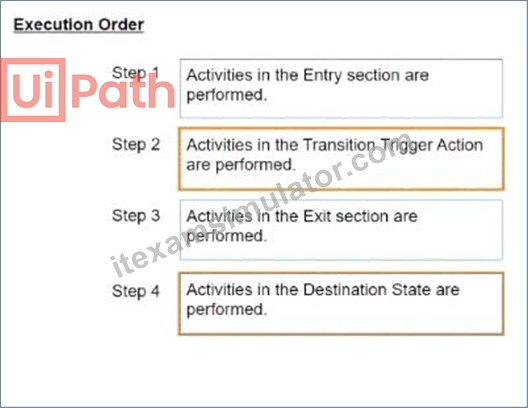
NEW QUESTION # 78
What is the correct execution order of the State activity sections?
instructions: Drag the Description found on the "Left" and drop on the correct Execution Order found on the
"Right"
Answer:
Explanation:
NEW QUESTION # 79
......
Focus on UiPath-ADPv1 All-in-One Exam Guide For Quick Preparation: https://www.itexamsimulator.com/UiPath-ADPv1-brain-dumps.html
UiPath-ADPv1 All-in-One Exam Guide For Quick Preparation: https://drive.google.com/open?id=1EYfnKLo805yHRfHteA65a5y7yniH8oIT
