

Verified Databricks-Certified-Data-Engineer-Associate dumps Q&As - 2024 Latest Databricks-Certified-Data-Engineer-Associate Download
Dumps Questions [2024] Pass for Databricks-Certified-Data-Engineer-Associate Exam
The GAQM Databricks-Certified-Data-Engineer-Associate (Databricks Certified Data Engineer Associate) Certification Exam is a comprehensive examination that tests the skills of professionals who work with data on the Databricks platform. Databricks Certified Data Engineer Associate Exam certification is designed for individuals who are responsible for designing, building, and maintaining data pipelines, as well as data analysts, data architects, and data engineers. The Databricks Certified Data Engineer Associate certification is recognized globally and validates the skills and knowledge of individuals in the field of data engineering.
Passing the Databricks Certified Data Engineer Associate Exam demonstrates that the candidate has the skills and knowledge necessary to design, build, and maintain data pipelines and data warehouses using Databricks. It is an important certification for data engineers who want to advance their careers and demonstrate their expertise in using Databricks to solve complex data engineering problems. With the explosive growth of data in today's business environment, the demand for skilled data engineers is higher than ever, and the Databricks Certified Data Engineer Associate Exam is an excellent way to stand out in a crowded job market.
NEW QUESTION # 52
Which of the following tools is used by Auto Loader process data incrementally?
- A. Spark Structured Streaming
- B. Checkpointing
- C. Unity Catalog
- D. Data Explorer
- E. Databricks SQL
Answer: A
Explanation:
Auto Loader provides a Structured Streaming source called cloudFiles that can process new data files as they arrive in cloud storage without any additional setup. Auto Loader uses a scalable key-value store to track ingestion progress and ensure exactly-once semantics. Auto Loader can ingest various file formats and load them into Delta Lake tables. Auto Loader is recommended for incremental data ingestion with Delta Live Tables, which extends the functionality of Structured Streaming and allows you to write declarative Python or SQL code to deploy a production-quality data pipeline. Reference: What is Auto Loader?, What is Auto Loader? | Databricks on AWS, Solved: How does Auto Loader ingest data? - Databricks - 5629
NEW QUESTION # 53
In which of the following scenarios should a data engineer use the MERGE INTO command instead of the INSERT INTO command?
- A. When the source table can be deleted
- B. When the target table cannot contain duplicate records
- C. When the target table is an external table
- D. When the source is not a Delta table
- E. When the location of the data needs to be changed
Answer: B
Explanation:
Explanation
With merge , you can avoid inserting the duplicate records. The dataset containing the new logs needs to be deduplicated within itself. By the SQL semantics of merge, it matches and deduplicates the new data with the existing data in the table, but if there is duplicate data within the new dataset, it is inserted.https://docs.databricks.com/en/delta/merge.html#:~:text=With%20merge%20%2C%20you%20can%20a
NEW QUESTION # 54
Which of the following data lakehouse features results in improved data quality over a traditional data lake?
- A. A data lakehouse enables machine learning and artificial Intelligence workloads.
- B. A data lakehouse supports ACID-compliant transactions.
- C. A data lakehouse stores data in open formats.
- D. A data lakehouse allows the use of SQL queries to examine data.
- E. A data lakehouse provides storage solutions for structured and unstructured data.
Answer: B
Explanation:
A data lakehouse is a data management architecture that combines the flexibility, cost-efficiency, and scale of data lakes with the data management and ACID transactions of data warehouses, enabling business intelligence (BI) and machine learning (ML) on all data12. One of the key features of a data lakehouse is that it supports ACID-compliant transactions, which means that it ensures data integrity, consistency, and isolation across concurrent read and write operations3. This feature results in improved data quality over a traditional data lake, which does not support transactions and may suffer from data corruption, duplication, or inconsistency due to concurrent or streaming data ingestion and processing . Reference: 1: What is a Data Lakehouse? - Databricks 2: What is a Data Lakehouse? Definition, features & benefits. - Qlik 3: ACID Transactions - Databricks : [Data Lake vs Data Warehouse: Key Differences] : [Data Lakehouse: The Future of Data Engineering]
NEW QUESTION # 55
A Delta Live Table pipeline includes two datasets defined using STREAMING LIVE TABLE. Three datasets are defined against Delta Lake table sources using LIVE TABLE.
The table is configured to run in Development mode using the Continuous Pipeline Mode.
Assuming previously unprocessed data exists and all definitions are valid, what is the expected outcome after clicking Start to update the pipeline?
- A. All datasets will be updated once and the pipeline will shut down. The compute resources will be terminated.
- B. All datasets will be updated once and the pipeline will shut down. The compute resources will persist to allow for additional testing.
- C. All datasets will be updated at set intervals until the pipeline is shut down. The compute resources will persist until the pipeline is shut down.
- D. All datasets will be updated at set intervals until the pipeline is shut down. The compute resources will persist to allow for additional testing.
- E. All datasets will be updated once and the pipeline will persist without any processing. The compute resources will persist but go unused.
Answer: C
Explanation:
The Continuous Pipeline Mode for Delta Live Tables allows the pipeline to run continuously and process data as it arrives. This mode is suitable for streaming ingest and CDC workloads that require low-latency updates. The Development mode for Delta Live Tables allows the pipeline to run on a dedicated cluster that is not shared with other pipelines. This mode is useful for testing and debugging the pipeline logic before deploying it to production. Therefore, the correct answer is B, because the pipeline will run continuously on a dedicated cluster until it is manually stopped, and the compute resources will be released only after the pipeline is shut down. Reference: Databricks Documentation - Configure pipeline settings for Delta Live Tables, Databricks Documentation - Continuous vs. triggered pipeline execution, Databricks Documentation - Development vs. production mode.
NEW QUESTION # 56
A data engineer only wants to execute the final block of a Python program if the Python variable day_of_week is equal to 1 and the Python variable review_period is True.
Which of the following control flow statements should the data engineer use to begin this conditionally executed code block?
- A. if day_of_week == 1 and review_period:
- B. if day_of_week == 1 and review_period == "True":
- C. if day_of_week = 1 and review_period = "True":
- D. if day_of_week = 1 and review_period:
- E. if day_of_week = 1 & review_period: = "True":
Answer: A
Explanation:
In Python, the == operator is used to compare the values of two variables, while the = operator is used to assign a value to a variable. Therefore, option A and E are incorrect, as they use the = operator for comparison. Option B and C are also incorrect, as they compare the review_period variable to a string value "True", which is different from the boolean value True. Option D is the correct answer, as it uses the == operator to compare the day_of_week variable to the integer value 1, and the and operator to check if both conditions are true. If both conditions are true, then the final block of the Python program will be executed. Reference: [Python Operators], [Python If ... Else]
NEW QUESTION # 57
Which of the following commands can be used to write data into a Delta table while avoiding the writing of duplicate records?
- A. APPEND
- B. INSERT
- C. MERGE
- D. IGNORE
- E. DROP
Answer: C
Explanation:
The MERGE command can be used to upsert data from a source table, view, or DataFrame into a target Delta table. It allows you to specify conditions for matching and updating existing records, and inserting new records when no match is found. This way, you can avoid writing duplicate records into a Delta table1. The other commands (DROP, IGNORE, APPEND, INSERT) do not have this functionality and may result in duplicate records or data loss234. References: 1: Upsert into a Delta Lake table using merge | Databricks on AWS 2: SQL DELETE | Databricks on AWS 3: SQL INSERT INTO | Databricks on AWS 4: SQL UPDATE | Databricks on AWS
NEW QUESTION # 58
A data engineer is using the following code block as part of a batch ingestion pipeline to read from a composable table: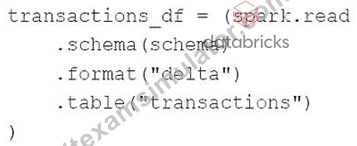
Which of the following changes needs to be made so this code block will work when the transactions table is a stream source?
- A. Replace spark.read with spark.readStream
- B. Replace schema(schema) with option ("maxFilesPerTrigger", 1)
- C. Replace format("delta") with format("stream")
- D. Replace predict with a stream-friendly prediction function
- E. Replace "transactions" with the path to the location of the Delta table
Answer: A
Explanation:
To read from a stream source, the data engineer needs to use the spark.readStream method instead of the spark.read method. The spark.readStream method returns a DataStreamReader object that can be used to specify the details of the input source, such as the format, the schema, the path, and the options. The spark.read method is only suitable for batch processing, not streaming processing. The other changes are not necessary or correct for reading from a stream source. References: Structured Streaming Programming Guide, Read a stream, Databricks Data Sources
NEW QUESTION # 59
A data engineer has configured a Structured Streaming job to read from a table, manipulate the data, and then perform a streaming write into a new table.
The cade block used by the data engineer is below: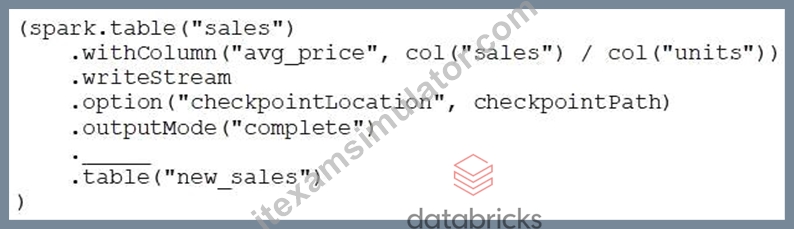
If the data engineer only wants the query to execute a micro-batch to process data every 5 seconds, which of the following lines of code should the data engineer use to fill in the blank?
- A. trigger("5 seconds")
- B. trigger(processingTime="5 seconds")
- C. trigger()
- D. trigger(once="5 seconds")
- E. trigger(continuous="5 seconds")
Answer: B
Explanation:
Explanation
# ProcessingTime trigger with two-seconds micro-batch interval
df.writeStream \
format("console") \
trigger(processingTime='2 seconds') \
start()
https://spark.apache.org/docs/latest/structured-streaming-programming-guide.html#triggers
NEW QUESTION # 60
Which of the following data lakehouse features results in improved data quality over a traditional data lake?
- A. A data lakehouse enables machine learning and artificial Intelligence workloads.
- B. A data lakehouse supports ACID-compliant transactions.
- C. A data lakehouse stores data in open formats.
- D. A data lakehouse provides storage solutions for structured and unstructured data.
- E. A data lakehouse allows the use of SQL queries to examine data.
Answer: E
NEW QUESTION # 61
A data engineer needs access to a table new_table, but they do not have the correct permissions. They can ask the table owner for permission, but they do not know who the table owner is.
Which of the following approaches can be used to identify the owner of new_table?
- A. There is no way to identify the owner of the table
- B. All of these options can be used to identify the owner of the table
- C. Review the Owner field in the table's page in the cloud storage solution
- D. Review the Permissions tab in the table's page in Data Explorer
- E. Review the Owner field in the table's page in Data Explorer
Answer: E
NEW QUESTION # 62
A data engineer wants to create a new table containing the names of customers that live in France.
They have written the following command:
A senior data engineer mentions that it is organization policy to include a table property indicating that the new table includes personally identifiable information (PII).
Which of the following lines of code fills in the above blank to successfully complete the task?
- A. COMMENT "Contains PII"
- B. PII
- C. There is no way to indicate whether a table contains PII.
- D. "COMMENT PII"
- E. TBLPROPERTIES PII
Answer: A
Explanation:
In Databricks, when creating a table, you can add a comment to columns or the entire table to provide more information about the data it contains. In this case, since it's organization policy toindicate that the new table includes personally identifiable information (PII), option D is correct. The line of code would be added after defining the table structure and before closing with a semicolon. References: Data Engineer Associate Exam Guide, CREATE TABLE USING (Databricks SQL)
NEW QUESTION # 63
Which of the following data workloads will utilize a Gold table as its source?
- A. A job that enriches data by parsing its timestamps into a human-readable format
- B. A job that cleans data by removing malformatted records
- C. A job that ingests raw data from a streaming source into the Lakehouse
- D. A job that aggregates uncleaned data to create standard summary statistics
- E. A job that queries aggregated data designed to feed into a dashboard
Answer: E
Explanation:
A Gold table is a table that contains highly refined and aggregated data that powers analytics, machine learning, and production applications. It represents data that has been transformed into knowledge, rather than just information. A Gold table is typically the final output of a medallion lakehouse architecture, where data flows from Bronze to Silver to Gold tables, with each layer improving the structure and quality of data. A job that queries aggregated data designed to feed into a dashboard is an example of a data workload that will utilize a Gold table as its source, as it requires data that is ready for consumption and analysis. The other options are either data workloads that will use a Bronze or Silver table as their source, or data workloads that will produce a Gold table as their output. References: Databricks Documentation - What is the medallion lakehouse architecture?, Databricks Documentation - What is a Medallion Architecture?, K21Academy - Delta Lake Architecture & Azure Databricks Workspace.
NEW QUESTION # 64
A data engineer has realized that they made a mistake when making a daily update to a table. They need to use Delta time travel to restore the table to a version that is 3 days old. However, when the data engineer attempts to time travel to the older version, they are unable to restore the data because the data files have been deleted.
Which of the following explains why the data files are no longer present?
- A. The HISTORY command was run on the table
- B. The DELETE HISTORY command was run on the table
- C. The VACUUM command was run on the table
- D. The TIME TRAVEL command was run on the table
- E. The OPTIMIZE command was nun on the table
Answer: C
NEW QUESTION # 65
A data engineer has three tables in a Delta Live Tables (DLT) pipeline. They have configured the pipeline to drop invalid records at each table. They notice that some data is being dropped due to quality concerns at some point in the DLT pipeline. They would like to determine at which table in their pipeline the data is being dropped.
Which of the following approaches can the data engineer take to identify the table that is dropping the records?
- A. They can navigate to the DLT pipeline page, click on each table, and view the data quality statistics.
- B. They can navigate to the DLT pipeline page, click on the "Error" button, and review the present errors.
- C. They can set up separate expectations for each table when developing their DLT pipeline.
- D. They cannot determine which table is dropping the records.
- E. They can set up DLT to notify them via email when records are dropped.
Answer: A
Explanation:
One of the features of DLT is that it provides data quality metrics for each dataset in the pipeline, such as the number of records that pass or fail expectations, the number of records that are dropped, and the number of records that are written to the target. These metrics can be accessed from the DLT pipeline page, where the data engineer can click on each table and view the data quality statistics for the latest update or any previous update. This way, they can identify which table is dropping the records and why. Reference:
Monitor Delta Live Tables pipelines
Manage data quality with Delta Live Tables
NEW QUESTION # 66
A data engineer has configured a Structured Streaming job to read from a table, manipulate the data, and then perform a streaming write into a new table.
The cade block used by the data engineer is below:
If the data engineer only wants the query to execute a micro-batch to process data every 5 seconds, which of the following lines of code should the data engineer use to fill in the blank?
- A. trigger("5 seconds")
- B. trigger(processingTime="5 seconds")
- C. trigger()
- D. trigger(once="5 seconds")
- E. trigger(continuous="5 seconds")
Answer: B
Explanation:
The processingTime option specifies a time-based trigger interval for fixed interval micro-batches. This means that the query will execute a micro-batch to process data every 5 seconds, regardless of how much data is available. This option is suitable for near-real time processing workloads that require low latency and consistent processing frequency. The other options are either invalid syntax (A, C), default behavior (B), or experimental feature (E). Reference: Databricks Documentation - Configure Structured Streaming trigger intervals, Databricks Documentation - Trigger.
NEW QUESTION # 67
A data engineer has been using a Databricks SQL dashboard to monitor the cleanliness of the input data to a data analytics dashboard for a retail use case. The job has a Databricks SQL query that returns the number of store-level records where sales is equal to zero. The data engineer wants their entire team to be notified via a messaging webhook whenever this value is greater than 0.
Which of the following approaches can the data engineer use to notify their entire team via a messaging webhook whenever the number of stores with $0 in sales is greater than zero?
- A. They can set up an Alert with a custom template.
- B. They can set up an Alert with a new webhook alert destination.
- C. They can set up an Alert with one-time notifications.
- D. They can set up an Alert with a new email alert destination.
- E. They can set up an Alert without notifications.
Answer: B
Explanation:
A webhook alert destination is a notification destination that allows Databricks to send HTTP POST requests to a third-party endpoint when an alert is triggered. This enables the data engineer to integrate Databricks alerts with their preferred messaging or collaboration platform, such as Slack, Microsoft Teams, or PagerDuty.
To set up a webhook alert destination, the data engineer needs to create and configure a webhook connector in their messaging platform, and then add the webhook URL to the Databricks notification destination. After that, the data engineer can create an alert for their Databricks SQL query, and select the webhook alert destination as the notification destination. The alert can be configured with a custom condition, such as when the number of stores with $0 in sales is greater than zero, and a custom message template, such as "Alert:
{number_of_stores} stores have $0 in sales". The alert can also be configured with a recurrence interval, such as every hour, to check the query result periodically. When the alert condition is met, the data engineer and their team will receive a notification via the messaging webhook, with the custom message and a link to the Databricks SQL query. The other options are either not suitable for sending notifications via a messaging webhook (A, B, E), or not suitable for sending recurring notifications . References: Databricks Documentation -Manage notification destinations, Databricks Documentation - Create alerts for Databricks SQL queries, Databricks Documentation - Configure alert conditions and messages.
NEW QUESTION # 68
......
Updated Databricks Study Guide Databricks-Certified-Data-Engineer-Associate Dumps Questions: https://www.itexamsimulator.com/Databricks-Certified-Data-Engineer-Associate-brain-dumps.html
